#215: Diary of a Mad Black Woman
Release Date: February 25th, 2005
Format: Streaming (The Roku Channel)
Written by: Tyler Perry
Directed by: Darren Grant
2 Stars
It’s been 20 years since Tyler Perry released his debut movie, The Diary of a Mad Black Woman. Since its debut, he has subsequently written and directed 30(!) feature films and amassed a fortune north of a billion dollars.
He is now a filmmaker with his own solar system in the form of his production company, Tyler Perry Studios, the largest film studio ever owned by a black American. Located in the greater Atlanta area, Perry oversees the production of all manner of films (not just Madea movies), television shows ranging from sitcoms to Divorce Court to Family Feud, and live spectacles like the Miss Universe pageant and the 2020 Democratic Presidential debates.
Once just a poor kid from an abusive household in New Orleans, a survivor of physical and sexual abuse who didn’t start writing until he heard on The Oprah Winfrey Show that it was therapeutic, Tyler Perry has made himself a king.
Watching The Diary of a Mad Black Woman tonight for the very first time, you can see his childhood. You can see his very essence. The Diary of a Mad Black Woman is Tyler Perry. Tyler Perry is The Diary of a Mad Black Woman.
Both the film and the man want validation, preferably from God. They are angry. They are traumatized by violence. They are funny. They want love, but seem sexually confused. They seek wisdom, which they find in the home and in the church. Redemption is never too late, and nothing is too magical. Anything is possible.
Like many inexperienced writers, Perry wisely draws from his own life. The narrative voice and the tone of The Diary of a Mad Black are undeniably distinctive. I found the film compelling.
But it’s also undeniably a melodrama, amateurish at times. Characterizations are cartoonish, their actions hyperbolic. The movie hits the same emotional high notes as a WWE storyline.
We have our “babyface” hero in the form of the beautiful Helen (Kimberly Elise), a loving, Christian wife of 18 years, and we have the “heel” villain in the form of her husband, the cheating and abusive attorney, Charles (Steve Harris). Not only does Charles cheat on the angelic Helen, but he’s fathered children with his mistress (Lisa Marcos), whom he flaunts around his office in front of his co-workers. When he breaks up with Helen, he doesn’t just kick her out of their mansion, but drags her kicking and screaming out the front door while the mistress looks on adoringly.
It’s some great heel work. Was Ric Flair a story consultant?
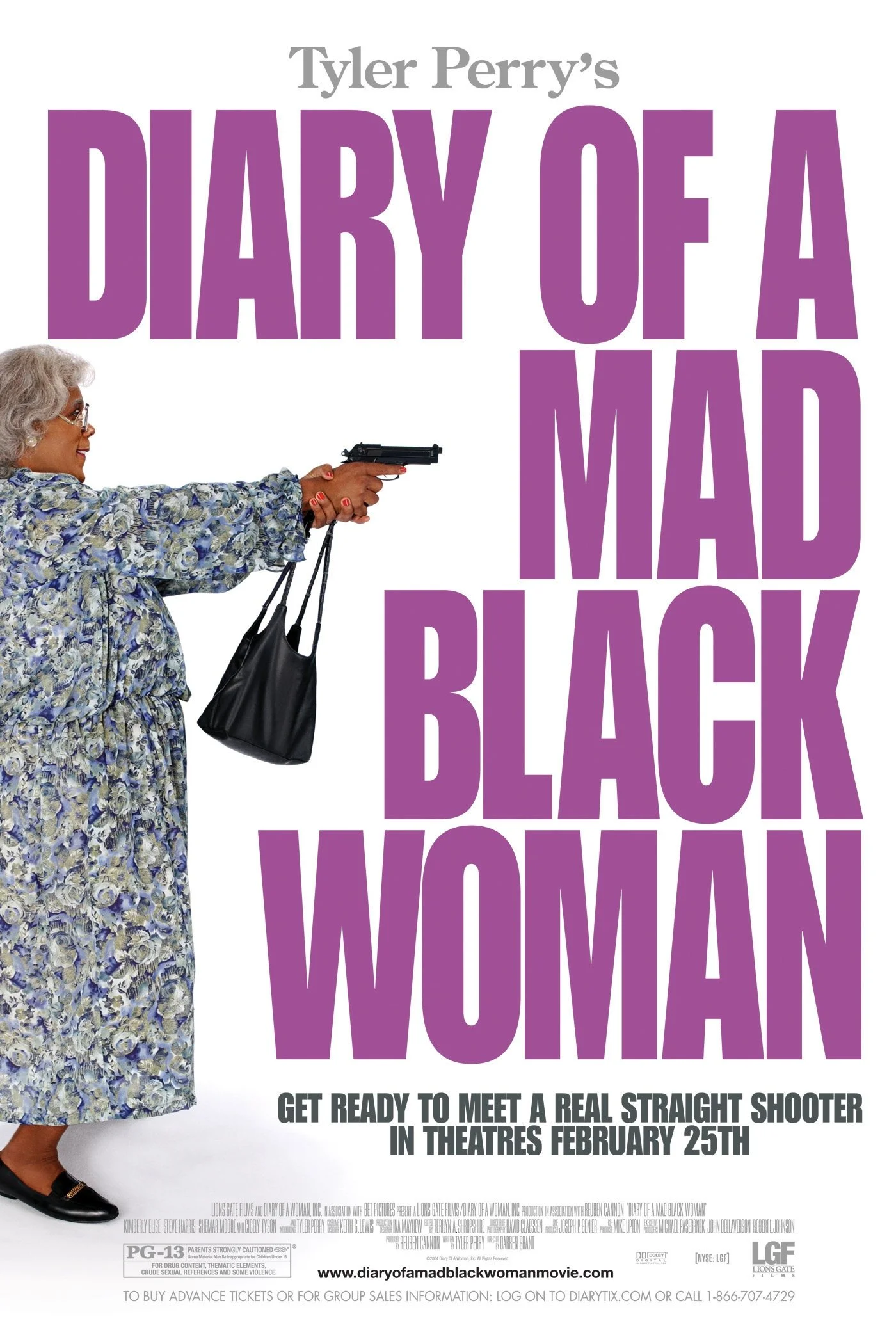
Now alone and broke, Helen must move in with her grandmother, Madea (played by Perry in drag), an enormous, gun-toting ol’ lady who might smack you or make you a stack of pancakes, depending on her mood. Pro wrestling has Madea types too. She is the anti-heroic ally with a good heart, but she’s no babyface. She’s there to do all the dirty work the babyface won’t do herself, which in this movie includes breaking and entering, destroying property with a chainsaw (where did she find that thing anyway?), assaulting people, and firing a gun indoors to make a point. It’s in Madea that we largely see a personification of Tyler Perry’s inner tumult, a strange brew of love and violence.
And with Madea on her side, Helen can now begin her babyface comeback story. She gets a job, meets a man named Orlando (Shemar Moore), and learns to love herself.
As the movie progresses, like wrestling, it gets more and more ludicrous. When our heel, Charles, is shot in the courtroom by a defendant he is representing, Helen leaves Orlando to care for him (I can practically hear the theater audience groaning in disappointment). She still wants to be the loving wife, despite the divorce proceedings and the mistress and the abuse. When the abuse absurdly still continues while Charles is paralyzed and wheelchair bound (“I'm Charles McCarter. I'm gonna die Charles McCarter. Look, I don't even know why you're here. I ain't giving you a dime…Get out!) Helen is tempted to “turn heel.”
Nearing the height of the film’s absurdity, she goes full Kathy Bates in Misery (#71) and holds Charles hostage in their home. She throws him headfirst into a bathtub and nearly allows him to drown to death. She starves him. She slaps him. Will she kill him? This is the movie’s equivalent of John Cena grabbing the steel chair, while the audience wonders if he’ll actually use it on his downed opponent.
But like a great babyface, she doesn’t kill him. She does what is right. She decides against vengeance and helps him through rehab like the good Christian wife that she is.
At the film’s climax, as well as its most melodramatic and ridiculous point, Helen goes back to church. During a triumphant sermon, Charles walks! Another character is cured of her drug addiction! Everybody is smiling and happy. God is good. Another heel will surely emerge, but not today, Satan. Today, God is good.
In a twist ending (do I need to give spoiler alerts for 20-year-old movies?) Helen signs the divorce paperwork, forfeits her wedding ring and her share of equity to Charles, kisses him on the head, and returns to Orlando to live happily ever after.
The movie becomes so pandering in the end that it might even be problematic.
Spike Lee once called Perry’s work “coonery and buffoonery,” and said that the imagery of his work is troubling: “All these characters are bait – disarming, charming, make you laugh bait. I can slap Madea on something and talk about God, love, faith, forgiveness, family, any of those.”
Spike’s point is valid, I think. Perry’s pandering messages and simplistic characters seem disingenuous. I think Tyler Perry is a smart businessman, not necessarily a good writer, but a smart enough businessman to know that he can make a buck talking down to his audience through his characters (not unlike wrestling promoters crafting characters for their audiences). Perry knows his audience, because he was part of this audience his whole life. They are churchgoing, working-class black Southerners who weren’t being portrayed by Hollywood. Tyler Perry is smart enough to give them representation, even if it’s overly simplistic.
This character is good. This one is bad. This one is pious. This one is a whore.
They all need church, just the bad ones need it more.
They’re simple characters, that is, except for Madea.
Madea seems to be the nexus of Tyler Perry’s psyche. She is the rogue antihero, the dumping ground for all his love, trauma, violence, and confused sexuality. Somehow she is the most authentic character in his debut film, this maternalistic 6’4” linebacker of a woman who carries a glock in her purse.
Watch the film and you’re not surprised that she is the breakout character. All the other characters are stock, but Perry invests something real into Madea, even if she is absurd.
So as part of my final thoughts on the film, I must mention that I’m obviously not the intended audience for The Diary of a Mad Black Woman. Perry has written this for black women, specifically black, southern, Christian women, and the protagonist Helen is intended to be a sort of avatar for them. I can’t speak on the film’s effectiveness and authenticity on those terms.
I will say that I was entertained. The anti-Hollywood qualities of the production and the writing are distinctive, and it clearly connected with audiences (the film made over $50 million on a $5.5 million budget and spawned over a dozen other Madea movies). In response to Spike Lee’s criticism, Tyler Perry said that their differences have to do with regionality and social class (Perry was born into a broken home in Louisiana; Lee is the product of two college-educated parents in New York City). I think Perry has a point.
But I also think Perry served up a film in The Diary of a Mad Black Woman that is troublesome. Like church leaders (or pro wrestling promoters), Perry knows that the poor and working-class are vulnerable to emotional pleas. With powerlessness, with poverty, comes a desire to believe in something greater, to believe that a pure heart will save you, even if that belief is only the length of a two-hour church service or a Tyler Perry movie.
It’s this manipulative aspect to The Diary of a Mad Black Woman that I didn’t enjoy, as entertained as I was.