#330: No Country for Old Men
Release Date: November 9th, 2007
Format: Criterion Collection on Blu-ray
Written by: Joel and Ethan Coen
Directed by: Joel and Ethan Coen
4 Stars
One could make all sorts of provocative statements about the Coen brothers’ 2007 classic, No Country for Old Men:
It’s their best film.
It’s the best film of the 21st century.
It’s the best movie ever made for ‘the snobs’ and ‘the slobs’ alike, a movie that simultaneously captures the existential terrain explored by Cormac McCarthy’s novel while also providing some thrilling psychopath-on-the-loose thrills and chills that you can enjoy while munching on some popcorn.
It’s a film that goes for your throat, then your mind, then your heart.
The story is a familiar one: A man finds a bunch of money and must decide whether or not to keep it. In this particular case the man is Llewelyn Moss (Josh Brolin, whose performance might be your favorite if you watch the movie as many times as I have), a Vietnam vet turned welder who lives a simple life with his wife Carla Jean (Kelly Macdonald, wry and heartbreaking) in a trailer in Sanderson, Texas, which is as quiet and dusty as it sounds. Also in this particular case, the money that Llewelyn finds belongs to a vicious Mexican drug cartel.
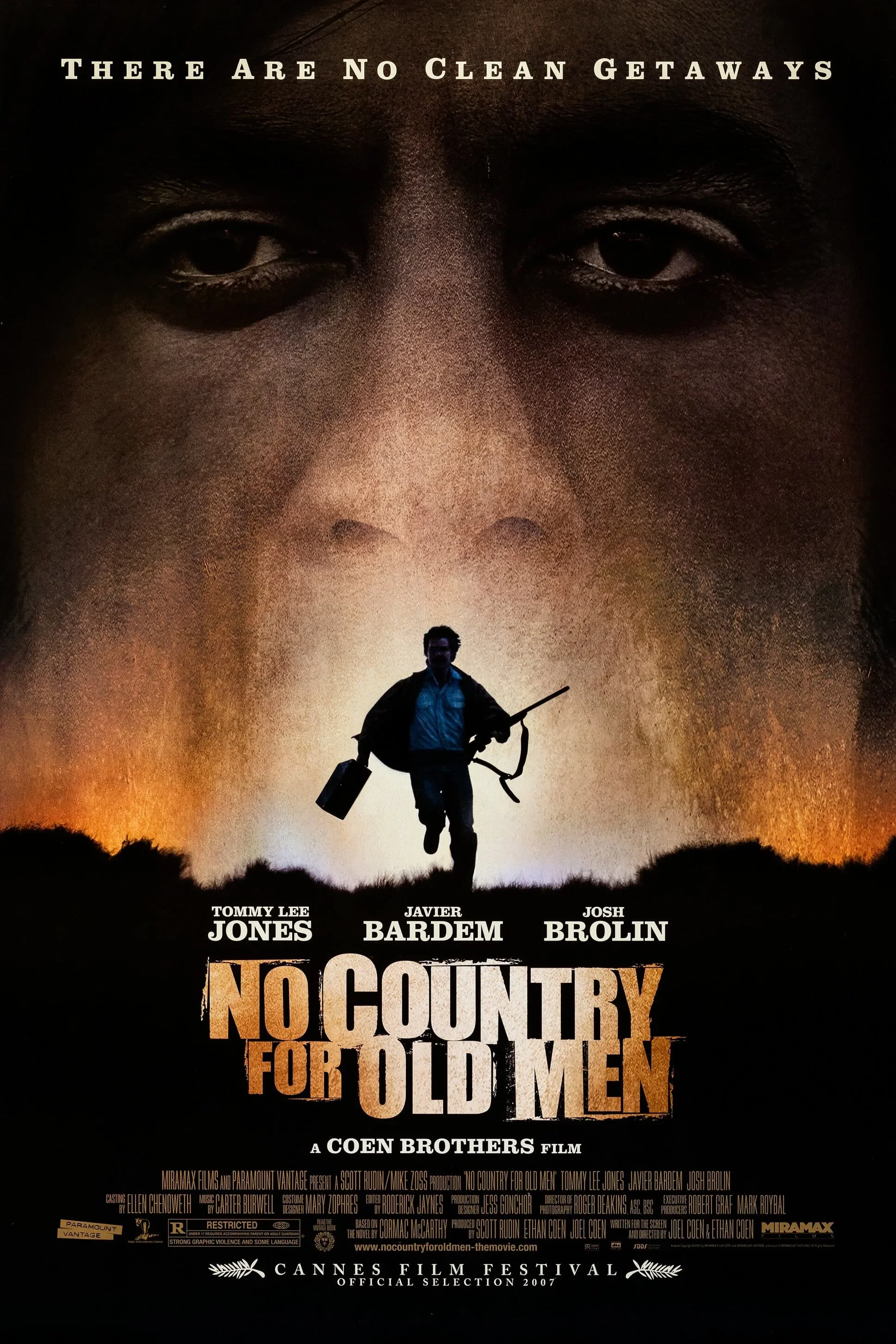
Unfortunately for Llewelyn he decides to take the money, setting in motion a relentless assassin-for-hire named Anton Chigurh (Javier Bardem), who follows Llewelyn’s every move, leaving a wake of dead bodies in his path.
Following both of these men is Sheriff Ed Tom Bell (Tommy Lee Jones), an aging lawman who’s finding it increasingly difficult by the day to make sense of the changing world around him.
All four of these central characters are ones we’ve seen before: the everyman, the caring wife, the killer, the lone lawman. We’ve seen this dusty setting and plot too.
But I’m not sure we’ve seen it all treated with such poignant reflection and cold fate. The Coen Brothers, via Cormac McCarthy, give us a parable that is as simple as it is challenging: Humanity’s heart of darkness is eternal, yet man is ephemeral. As we age, as our flesh weakens and our internal defenses against the indifference of the universe soften, we more desperately cling to traditions. We hope that marriage, or religion, or just about any familiar societal custom can supplant our diminishing vitality, and if we start losing those customs, the world becomes an increasingly scary place for the old.
While reflecting on what he sees as the breakdown of society, Sheriff Ed Tom Bell laments to a fellow cop, "I think that once you quit hearing 'sir' and 'ma'am,' the rest is soon to foller." The Sheriff needs this self-assurance that it’s not him, but it’s the world around him that is falling into disrepair. Sure I’m getting older, the Sheriff must think, but if we raised these damn kids with some manners we could clean this country up.
This self-delusion is soon snuffed out when Ed visits an elderly relative, Ellis, at his home. Ellis is a retired lawman and notices a change in Ed. When Ed probes Ellis for some solace, or at least some advice, about the changing world around him, Ellis recounts to Ed the killing of his uncle Mac, at the hands of murderous posse before Ed was born:
Ellis: “Shot down on his own porch there in Hudspeth County. There was seven or eight of 'em come to the house. Wantin' this and wantin' that. Mac went back in and got his shotgun but they was way ahead of him. Shot him down in his own doorway. Aunt Ella run out and tried to stop the bleedin'. Him tryin to get hold of the shotgun again. They just set there on their horses watchin' him die. Finally one of 'em says somethin' in Injun and they all turned and left out. Well Mac knew the score even if Aunt Ella didn't. Shot through the left lung and that was that…as they say…”
[Ellis looks at Ed, considering what wisdom he can offer his kin]
Ellis (cont.): “What you got ain't nothin' new. This country is hard on people. Hard and crazy. Got the devil in it yet. Folks never seem to hold it to account…”
Ed: “I’m…discouraged”
Ellis: “You can't stop what's comin. Ain't all waitin' on you.”
The supposed loss of morality and common sense that Sheriff Ed Tom Bell feels, the loss of basic human decency, is nothing new for an aging lawman. His uncle Mac felt it, his father Ed Tom Bell Sr., who was also a Sheriff, felt it too. Ellis felt it.
It’s an eternal conflict for certain older men, aging protectors who without their strength and their convictions are left with no country.
Instead they’re left with a reality that is impartial and cold, and find themselves small and beholden to a chaotic world that they can no longer control, or at least feel some sense of control. Marriage and family and ‘sir’ and ‘ma’am’ are no longer the bedrocks of their lives, but rather life preservers against uncertainty, and ultimately, death.
You don’t need to understand Anton Chigurh, but don’t deny that he’s on his way.
Mercifully, McCarthy and the Coens end the film with a warm, existential sentiment (despite the story’s tragic and murderous path). Ed Tom Bell, now retired and spending his days with his loving wife, sits at the breakfast table and recounts two dreams that he had the night before: In the first dream, he loses some money that his father gave him. In the recounting of the second dream, the retired Sheriff implies that he’s found some sense of inner peace.
In his words, he’s riding horseback at night alongside his father in olden times:
“It was cold and snowin', hard ridin'. Hard country. He rode past me and kept on goin'. Never said nothin' goin' by. He just rode on past and he had his blanket wrapped around him and his head down and when he rode past I seen he was carryin' fire in a horn the way people used to do and I could see the horn from the light inside of it. About the color of the moon. And in the dream I knew that he was goin' on ahead and that he was fixin' to make a fire somewhere out there in all that dark and all that cold, and I knew that whenever I got there he would be there. Out there up ahead.”