#358: Once Upon a Time in Hollywood
Release Date: July 26th, 2019
Format: Blu-ray
Written by: Quentin Tarantino
Directed by: Quentin Tarantino
4 Stars
Once Upon a Time in Hollywood is the film that Quentin Tarantino has been building towards his entire career, and the film in which he, more than any other filmmaker, seems singularly capable of making. The film is a culmination of his life, really, this latch key Torrance kid that was raised by a single mother (when she was home) and American television (when she wasn’t). Teenage Quentin would later drop out of high school, get a part-time job at a porno theater, and ride the bus all over LA feeding his growing cinephilia with trips to decrepit movie palaces downtown, drive-in theaters in the valley, and a black grindhouse theater in neighboring Carson. A few years later, famously, came his job at Video Archives and some fledgling acting gigs, before Quentin finally got his foot in the industry door as the writer of the captivating, ultra-violent crime flicks True Romance and Natural Born Killers. When he made his film debut as writer/director of Reservoir Dogs in 1992, the rest, as they say, is history.
Crucial to the Tarantino legend was his enormous capacity as a young man for American pop culture knowledge. Yes, film especially, but also American music, television, cartoons, popular fiction, radio, Hollywood chronicles (spanning back to the early Golden Era), and all manner of advertising, from billboards to jingles to kitschy network TV tag lines promoting such exciting things as the next episode of The F.B.I. or Mannix.
If he were born 50 years later it seems likely that a young Quentin would be diagnosed as neurodivergent, possibly autistic, and given an IEP at his Torrance elementary school to better help him succeed in school. But in the malaise of the 1970s little Quentin was largely left to his own devices, considered by the adults in his life as a cool little kid, but a strange little kid. Smart, though. Not good at school, but smart. Maybe a savant.
When I watch Once Upon a Time in Hollywood, which I’ve seen several times in the seven years since its release, it’s through this autobiographical lens that I appreciate the film. Tarantino sets the movie in 1969, and by doing so gets to finally utilize all of those distant memories that he accumulated as a sensitive, inquisitive, smart little boy.
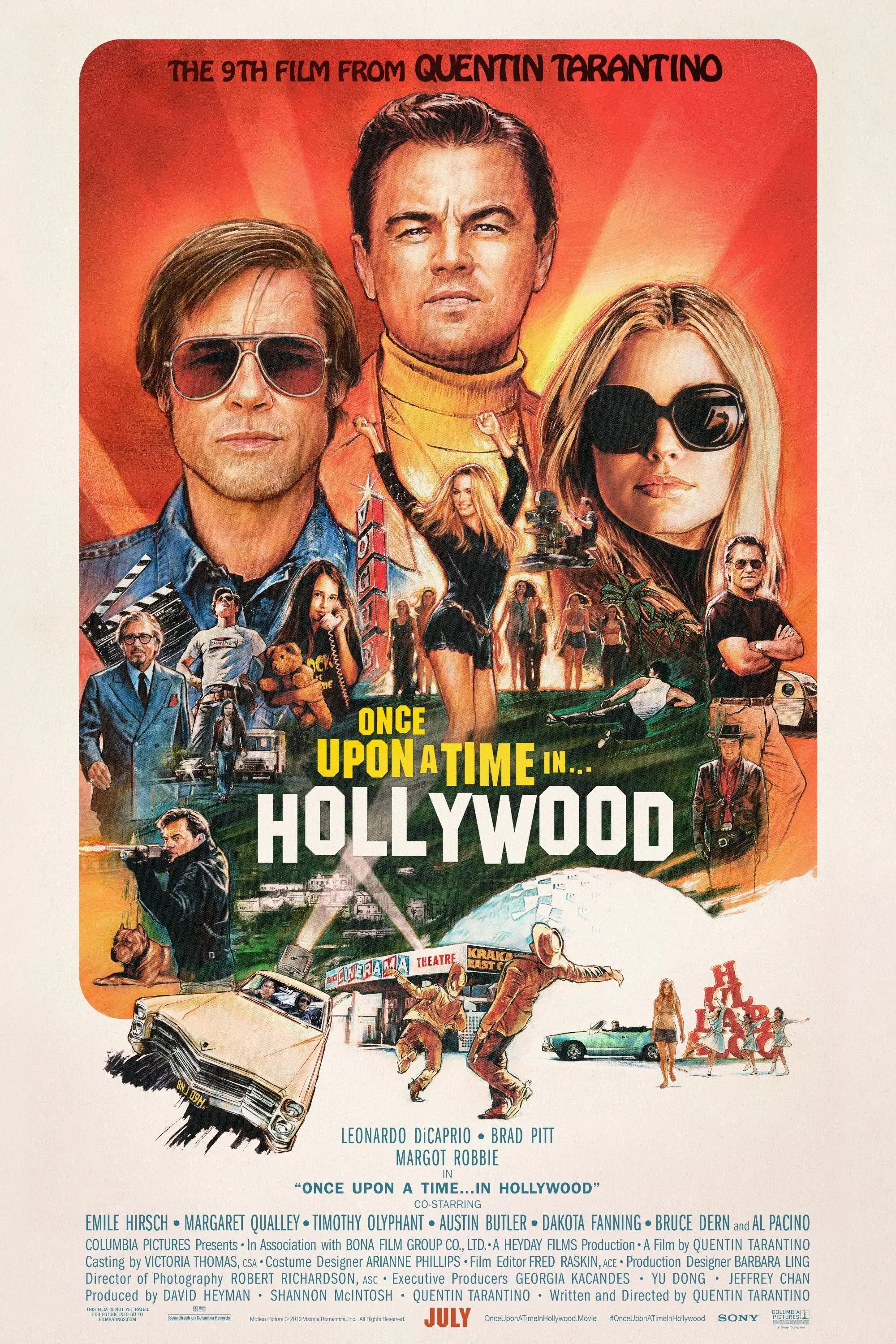
The movie is his playground: His fictional main characters are an over-the-hill TV star named Rick Dalton (Leonardo DiCaprio) and Rick’s stunt double Cliff Booth (Brad Pitt), who are struggling to adapt to the cultural sea change happening in late-‘60s Hollywood, where tough guys with crew cuts are out and groovy cats in fringe jackets are in; living next door to Rick in the Hollywood Hills is the beautiful, pregnant Sharon Tate (Margot Robbie) and her husband, the hottest young director in town, Roman Polanski (Rafał Zawierucha); and far across the valley, deep in Chatsworth, looms the spectre of mayhem and violence that is the Manson family.
In between our central characters, Tarantino gleefully allows himself to flesh out an entire world. You can feel his enthusiasm, which has always been one of his greatest strengths as a filmmaker.
God he loves this stuff.
In …Hollywood he gets to create the total rise, fall, and redemption of the fictional career of Rick Dalton, from his star turn in TV’s Bounty Law, to his lesser guest-starring roles in the mid-’60s, to a movie career that suggested possible A-list stardom (he almost got McQueen’s role in The Great Escape) but modestly settles down for starring roles in Italian spaghetti westerns. Tarantino fell so in love with his own Rick Dalton mythology that he wrote a novelization of his movie a couple of years later (a fun read).
Besides the fictional Rick Dalton (as well as the entertaining Cliff Booth character, whom I look forward to writing about more in-depth when the David Fincher-directed spinoff sequel, The Further Mis-Adventures of Cliff Booth, comes out this fall) Tarantino also gets to play around with all the real-life ephemera that he’s kept stored in his brain since the mid-’60s.
…Hollywood wistfully curates an image of Los Angeles that I want to believe truly existed (Tarantino overwhelms us, makes us believers): local radio DJs spin tunes for drivers with their windows down on the 101, dirty hippy girls bounce down the street with stolen jars of pickles and bags of chips, mid-century modern homes feature wet bars and swanky wall-to-wall carpet (that must reek of pot and cigarette smoke), and all of it luxuriates under a gloriously warm California sun.
It’s a love letter to a time and place, and although Tarantino will never again capture the cultural zeitgeist the way he did with Pulp Fiction, Once Upon a Time in Hollywood is his best film.
Postscript: It’s too bad Quentin is limiting himself to a ten picture filmography (...Hollywood is #9, so he’s only got one more movie left in the chamber). His rationale is that he doesn’t want to be the out-of-touch old guy who has lost his filmmaking fastball, but if you’ve just made the best picture of your career then that logic seems a bit silly. It’s not as if his filmography is perfect to begin with, either (Death Proof isn’t very good, nor The Hateful Eight). C’mon Quentin, make us a ‘70s detective flick, and then a body horror movie, then a heist picture. Do that Vol. 3 of Kill Bill. If Eastwood and Scorsese can keep their directorial dicks up way into their 80s, you should be able to, too.