#298: Interstellar
Release Date: November 7th, 2014
Format: Blu-ray
Written by: Christopher Nolan and Jonathon Nolan
Directed by: Christopher Nolan
4 Stars
I finally got around to watching Interstellar for the first time - you’re welcome, Steven - and I came away with two equal but opposite reactions:
1. This is an intellectually challenging sci-fi epic, the likes of which we probably haven’t seen on this big a scale since Kubrick’s 2001: A Space Odyssey, and it moved me to tears.
2. I somehow still don’t think that Christopher Nolan is a filmmaker who speaks deeply to me.
And that’s okay. There’s no prerequisite that a great filmmaker or a great film - and I think Interstellar is a great film - needs to be universally appealing. In fact it might be more of the opposite. In the case of Nolan, I find his storytelling to be a bit elitist at times. He’s an engrossing storyteller, but his natural tendency is towards stories in which faceless masses of simple humans are threatened by forces they’re too dumb to understand. Then Nolan gives us a hero - straight, white, well-educated, oftentimes privileged (think Batman, Oppenheimer) - who can save humanity like a shepherd protecting his flock.
He’s also a storyteller who tends to withhold. He loves plot, but he withholds, so that you’re almost leaning in towards the screen. Isn’t that a bit elitist too? It’s as if Nolan is holding all of the cards, and if we’re a good little audience and follow his commands, he’ll show you a quick peek of them. Maybe he’ll even give you one or two. I think this ties into a major complaint people have regarding Nolan’s sound mixes, that the dialogue is hard to hear and understand. I think that’s intentional. Nolan is withholding.
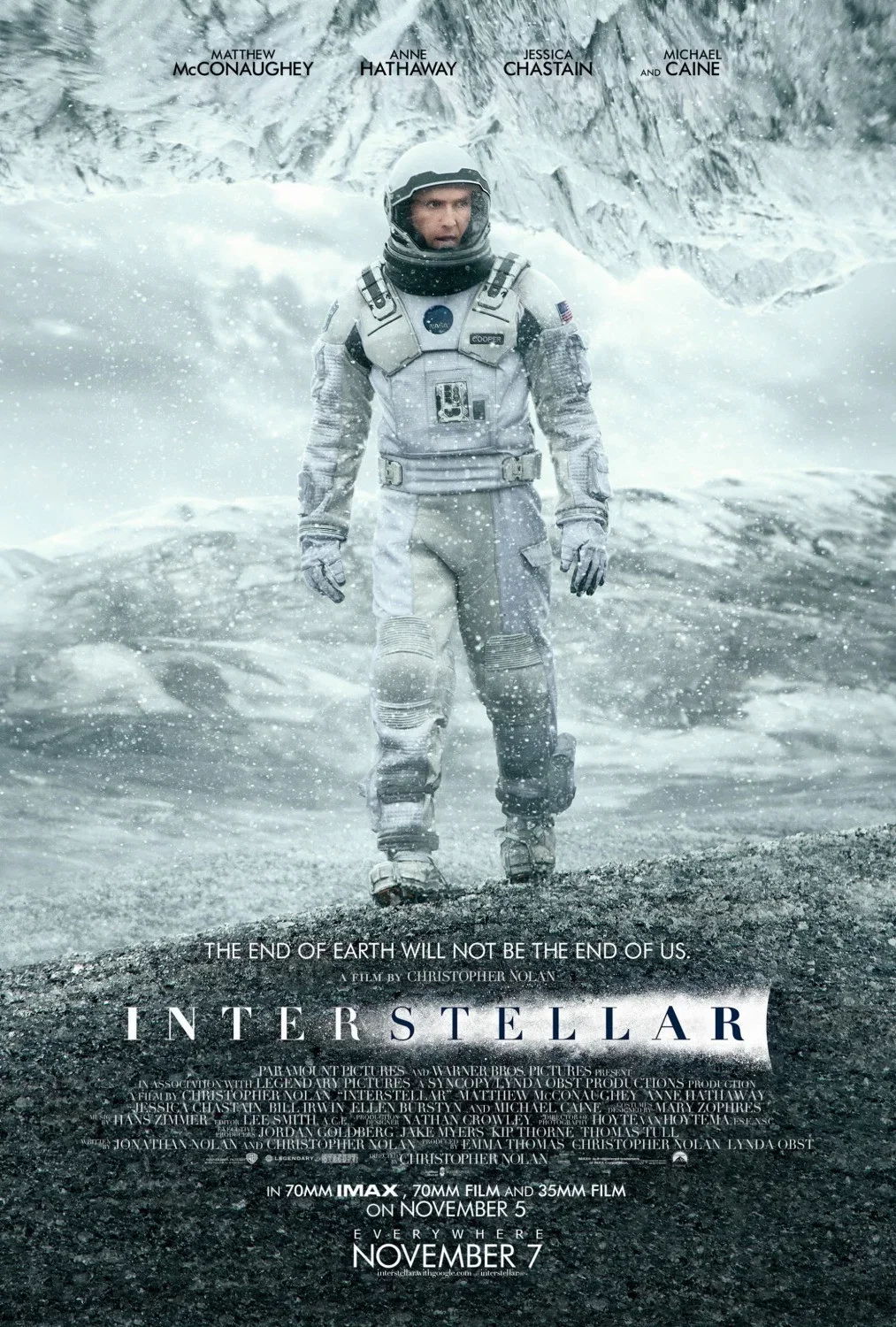
But enough complaining, let’s talk about what an achievement Interstellar is. My god, it’s enormous, visually, spatially, conceptually. The story takes place in the near future and concerns retired NASA pilot Joe Cooper (Matthew McConaughey), now a corn farmer, whose brilliant 10-year-old daughter, Murph (as in Murphy’s Law; Mackenzie Foy), is receiving some sort of communication from beyond; dust gathers in strange patterns on her bedroom floor. Cooper and Murph attribute it to a gravitational pull, and then translate the pattern to geographic coordinates (don’t ask me how).
After driving through the night to the coordinates, Cooper and Murph arrive upon an underground - literally - NASA headquarters. Once brought inside by security, they meet Professor John Brand (Michael Caine), who lays out exactly what is going on: 48 years ago, astronomers found a black hole near Saturn that leads to a different galaxy, in which there are twelve planets that may be able to sustain human life. Twelve astronauts were sent, one to each planet, to record data and transpond their findings back to Earth; three of those planets showed promising signs. Now is the time to re-visit those three planets, and time is crucial, Prof. Brand explains, because Earth is dying and humanity needs a new home within a generation. Cooper knows this first hand, as he’s observed the rampant blight infecting the farmland surrounding his family’s home over the course of his life.
Despite Murph’s dire pleading to stay on Earth, Cooper agrees to pilot the spaceship Endurance through the black hole to visit each of the three potentially hospitable planets. On board is a small crew, including Prof. Brand’s daughter, Amelia (Anne Hathaway), who has her own personal reasons for undertaking this voyage.
I’ll spare you any additional plot synopsis - as I said, Nolan loves plot - just to say that Interstellar ends up being about the relationship between scientific truths - things that we can measure and record and reproduce - and the unexplainable.
When I say unexplainable, I’m including love. Nolan leaves us with that possibility, that it’s love that may be the binder to all things physical and metaphysical.
Is Nolan pulling the rug from under my feet with the science of this movie? Probably. He might regard me as just one of the simple humans in the faceless masses that watch his blockbuster movies, but I can still appreciate what he’s reaching for with this film. He’s taking us to other worlds, other galaxies, beautiful and disparate places we don’t understand, just to arrive back at the enormity of a father’s love for his daughter.
We can understand that.