#312: Crazy Mama
Release Date: November 7th, 1975
Format: Streaming (Tubi)
Written by: Robert Thom
Directed by: Jonathan Demme
3.5 Stars
Most likely intended as a cheap, femme-fatales-on-the-loose exploitation flick by B-movie legend Roger Corman, Crazy Mama instead ends up being a humanistic romp, with heaps of familial love and an empathetic portrayal of working-class struggle.
Attribute this to director Jonathan Demme, then only 31-years-old and working on just his second feature film. Despite his youth, inexperience, and typical Cormanian production cheapness (Demme almost backed out during pre-production because he doubted he could make a decent picture as cheaply and quickly as Corman demanded; Corman responded by threatening to scrap production on Demme’s next film, Fighting Mad), it’s obvious watching Crazy Mama that this is a beautiful auteur at work, despite his penny-pinching producer.
Crazy Mama is about three generations of women who have their hair salon re-possessed by creditors in Long Beach, California in 1958, so they pack whatever they have left and head back east to hopefully buy their family’s old farmstead in Jerusalem, Arkansas.
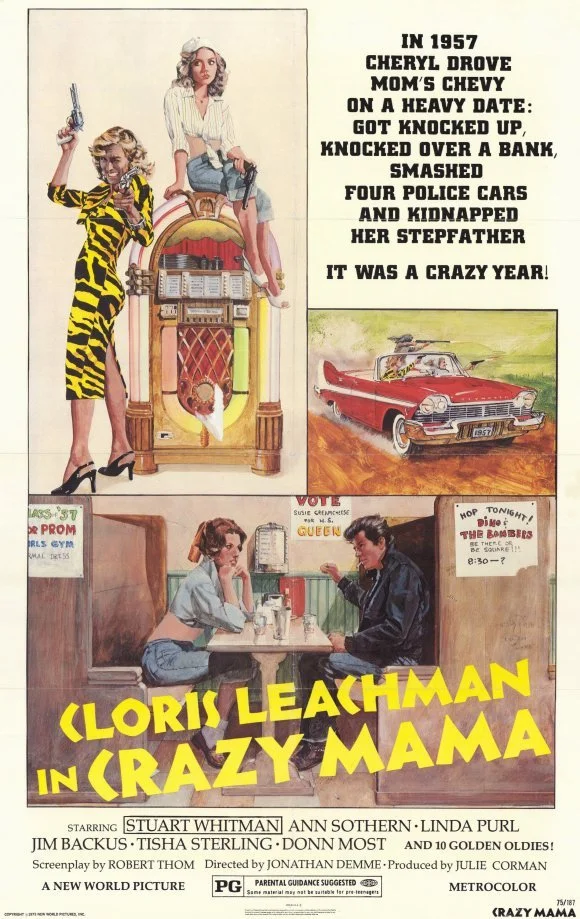
There’s the sardonic grandmother, Sheba (Ann Sothern); her spitfire daughter, Melba (Cloris Leachman); and the naive granddaughter, Cheryl (Linda Purl). Along their journey they attract a menagerie of male suitors, like Shawn (Donny Most), who may have gotten Cheryl pregnant back in Long Beach; he’ll follow the women across the country in his station wagon. There’s also Snake (Bryan Englund), a young greaser that catches Cherl’s eye, and a runaway Texas Sheriff, Jim Bob (Stuart Whitman), who falls in love with and marries Melba in a cheap chapel on the Las Vegas strip. They also adopt Bertha, a dear old octogenarian they meet in Vegas, who passes her time alone in the casinos, praying to God and playing the slots; her family members have all passed away and she has no one left.
This ragtag family of misfits continues their journey eastward, robbing unsuspecting victims in hopes of saving enough money for that ol’ farm in Arkansas. They almost make it, and Demme’s ending walks a tightrope between shoot ‘em up shenanigans and touching melodrama. It’s astounding how well he manages that.
The Corman-Demme marriage is not perfect, though, as much as I really enjoyed Crazy Mama. The film is a bit rough around the edges, not disjointed exactly, but uneven at times. I bet Demme would have killed for just one extra week on his filming schedule.
That said, my goodness does this movie have heart. Demme is such a warm filmmaker, who cares deeply about the human beings that are in front of his lens. Even if it is just a cheap Corman B-movie, he honors his performers. He cares for them and their portrayals.
I’ve written about another auteur who approaches his filmmaking in this manner, P.T. Anderson. Anderson was once asked who were his three most inspiring filmmakers and he replied, “Jonathan Demme, Jonathan Demme, and Jonathan Demme.”