#314: Snow White and the Seven Dwarfs
Release Date: February 4th, 1938
Format: Streaming (Disney+)
Written by: Richard Creedon, Merrill De Maris, Otto Englander, Earl Hurd, Dick Rickard, Ted Sears, Webb Smith
Directed by: David Hand
4 Stars
There are few films that change the trajectory of cinema, but Walt Disney’s (the man, as much as the company) Snow White and the Seven Dwarfs is one such movie.
Walt put it all on the line to see the movie through its massive production - including taking out an additional mortgage on his house - and there were plenty of naysayers at the time who made sure to tell him that a feature-length animated film would never work.
How are you going to keep the attention of children for 90 minutes? How are you going to write enough gags to keep the thing afloat? And how much is all this going to cost?
The final bill came out to a monstrous $1.5 million, an astonishing amount for a genre that previously existed as rather primitive cartoon kiddie shorts.
Money. Well. Spent.
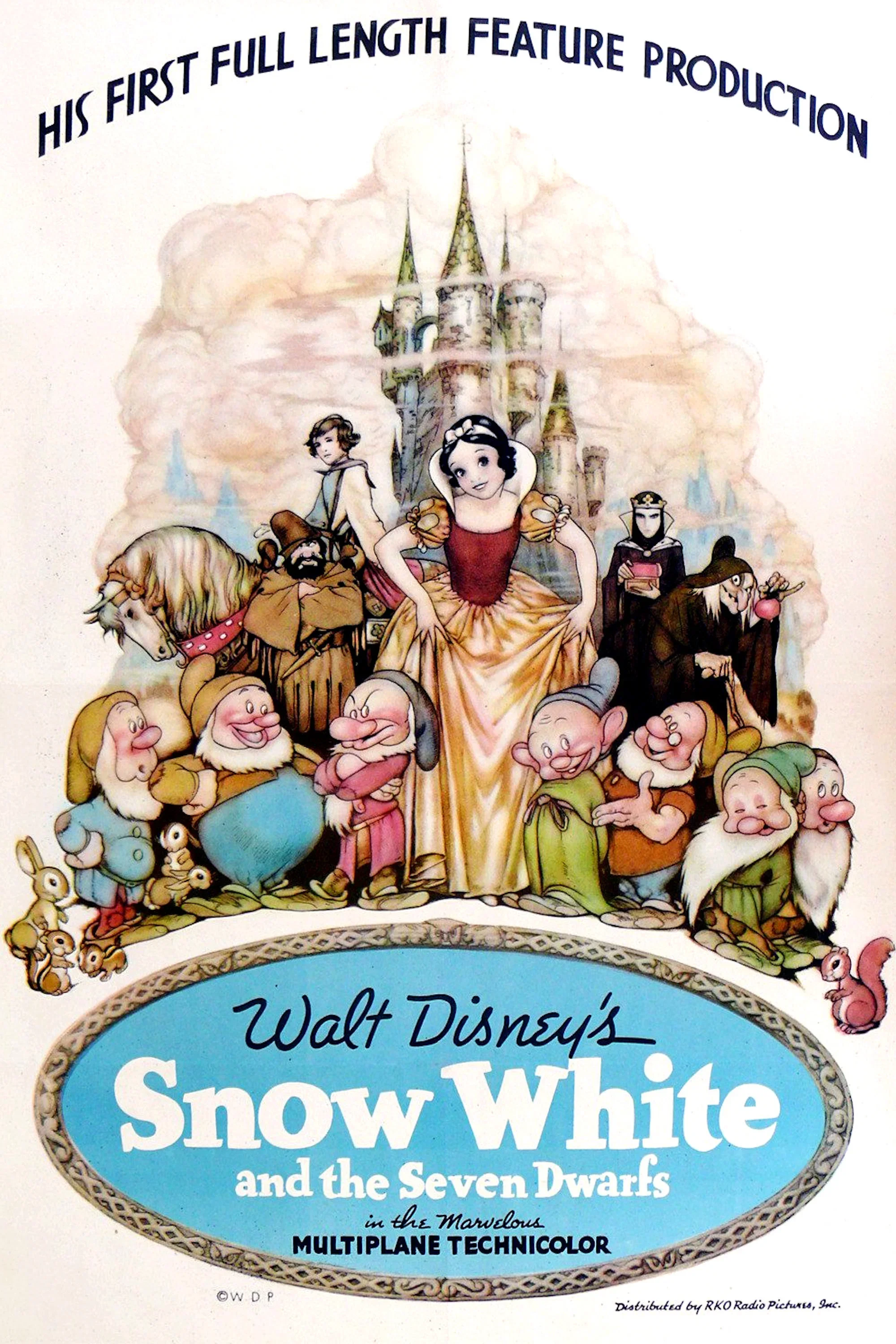
Snow White and the Seven Dwarfs was an astonishing success, a technically brilliant animated motion picture that opened the doors for what Walt Disney would eventually become: a visionary builder of dreams.
Watching it tonight for the first time in its entirety (I know, I know), I was surprised to see how faithfully Walt’s writers stuck to the simplicity of its source material, an over 100-year-old Brothers Grimm’s fairly tale: An evil Queen orders the assassination of her beautiful step-daughter, Snow White, only for Snow White to escape into the neighboring forest. There she befriends seven dwarfs and awaits her Prince Charming. Relentless, the evil Queen transforms herself into an old peddler, ventures out into the forest, and tricks Snow White into eating a poison apple, which puts her into an eternal sleep. Out of loyalty and love, the dwarfs keep Snow White entombed in a glass coffin, where she is kept until the day her Prince Charming visits and kisses her, breaking the spell. She bids adieu to her faithful dwarfs and goes off to the Prince’s kingdom and lives happily ever after.
If Walt had insecurities about filling the 90 minute runtime, it doesn’t show. He confidently places Snow White in a basic three-act structure, with flat characters and a simple theme. At its core, it remains a fairytale.
But what a gorgeous fairytale. Walt and his team imbue the film with beautiful imagery. The iconography here is universally recognizable: Snow White, in her blue and yellow dress, running through the forest; the evil Queen, draped in purple and black, glaring into her Magic Mirror; each bearded dwarf, lovable in his own way; a poison red apple; a kiss of life.
I was also surprised to see how much of the Brothers Grimm’s overtly Germanic qualities were left in Snow White. It’s a dark tale, where characters are threatened with stabbings, poisonings, and being buried alive. The animations have German expressionistic qualities, too; the surrounding forest and the old peddler woman would fit right in with a 1920s Robert Wiene film.
Snow White combines this beautiful, haunting imagery with eternal themes and Disney’s state-of-the-art animations. It remains a high-water mark for animated feature films to this day.