#252: Seven
Release Date: November 30th, 1991
Format: DVD
Written by: Andrew Kevin Walker
Directed by: David Fincher
4 Stars
Seven was the film that was going to make or break David Fincher. A successful A-list music video director for artists such as Madonna, Michael Jackson, and the Rolling Stones, Fincher saw his maiden voyage into feature films go down in flames when the studio re-edited his directorial debut, Aliens 3. The results were disastrous in Fincher’s eyes, and mostly underwhelming in the eyes of audiences and critics. He disavowed Aliens 3, and promised himself to never let a studio mettle in another one of his projects again, even if it meant retiring from feature film-making. All of this turmoil tarnished his young career, and in the eyes of many in the industry, he went from following in the footsteps of Ridley Scott and James Cameron, to being just an overhyped young director who was always more style than substance. Fincher needed a reset.
If Fincher was battling in the trenches of the industry, writer Andrew Kevin Walker wasn’t even in the war. For Walker, the late ‘80s were not spent hanging out with Madonna on the set of the music video for “Vogue,” but rather just being a high school kid in Mechanicsburg, Pennsylvania who loved movies, especially the darker ones. Horror, film noir, creature features…Walker loved the “cinema of discomfort” as he calls it, namely movies that put the viewer in a place that they would never want to be in real life. After graduating from Penn State University with a degree in film and video production, Walker moved to New York City and got a job at Tower Records. It turned out to be his own real-life cinema of discomfort, where he lived amidst the drug addiction, AIDS, and crime epidemics that were shaking NYC at the time.
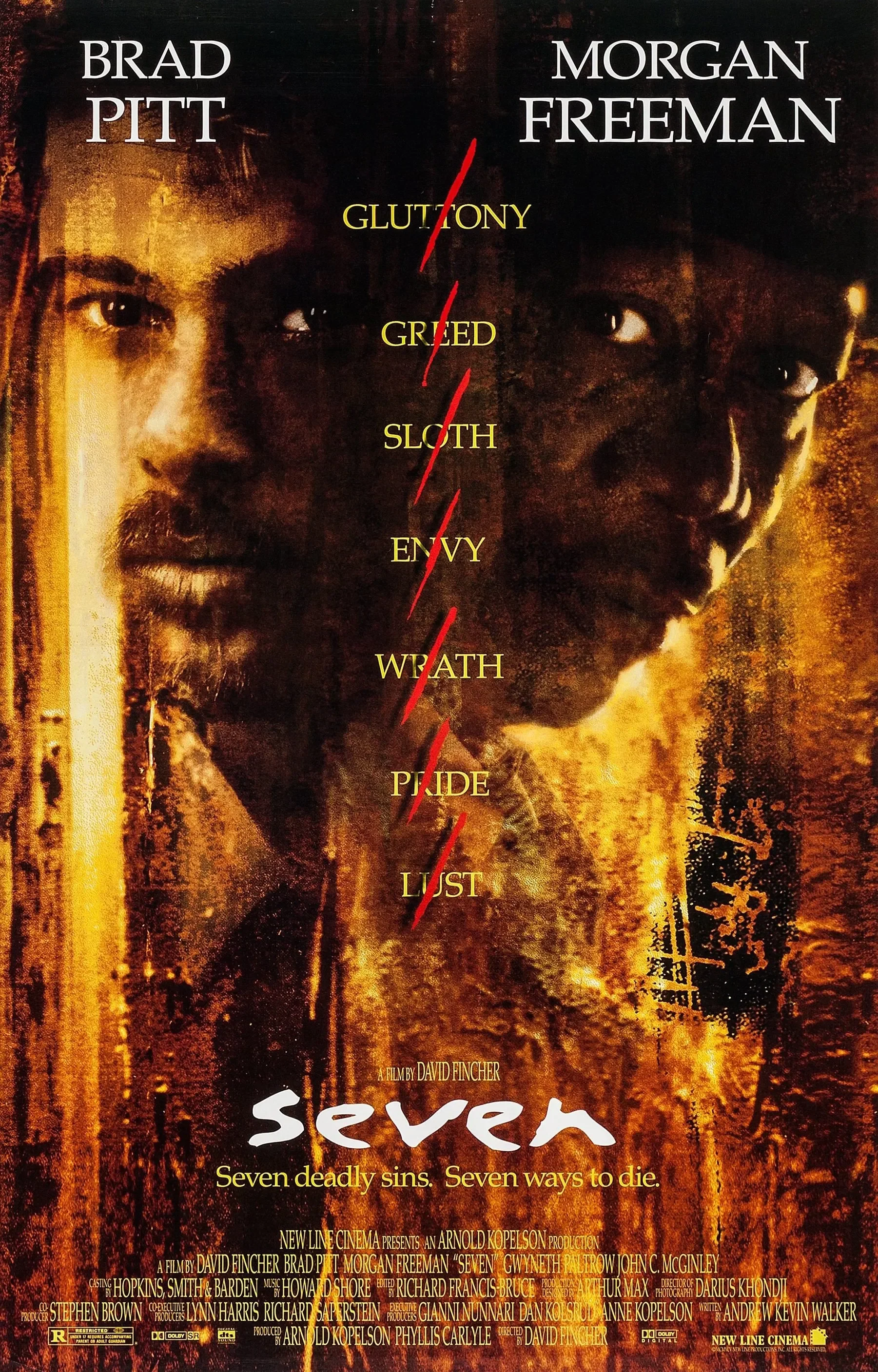
So he started writing. While Fincher was fighting studio execs on the set of Aliens 3, Walker began a spec script about a young detective named Mills (Brad Pitt) who is assigned to an unnamed big city, a real hellhole, to replace a wizened older detective named Somerset (Morgan Freeman) who just can’t handle the job anymore. For Somerset, his job no longer seems to have anything to do with justice. Instead, he tells Mills, he just collects evidence that gets filed away in a drawer somewhere. His life’s work is curating this dark library of apathy.
But while Mills is shadowing Somerset, they are called to a crime scene where they find an enormous man in a basement. He is sitting at his kitchen table, face down in a plate of spaghetti. Roaches skitter across the floor and walls. His hands and feet are bound, and written in grease on the wall is the word, “gluttony.” A coroner tells Mills and Somerset that the man literally ate himself to death. There’s also a nasty bruise on the back of the man’s head, likely from a pistol being pressed against it for a prolonged period of time.
Who would take the time to do this to a person? Somerset believes this is the work of a purposeful serial killer who has larger ambitions. His captain (R. Lee Ermey), and Mills, think Somerset is just getting a little kooky in his old age. Somebody probably just had a problem with the fat man and tortured him to death, they tell Somerset. But when a high profile criminal defense lawyer is found slain in his office the next day, and the word “greed” is written in blood on the white carpet floor, the two detectives know for certain that there is a psycho on the loose.
Walker sent his script out to anyone willing to read it, and an Italian studio named Penta Film optioned it for the industry minimum wage. Still, it was enough to encourage Walker to pack up his things and move to Los Angeles. Once there, Penta Film tasked him with softening the darkest aspects of his script, especially his nihilistic ending. New to the business and at the mercy of film execs (much like Fincher), Walker spent over a year re-writing this script of his, about a serial killer who targets seven victims, each of whom have committed one of the seven deadly sins. He would go on to write thirteen unsatisfactory drafts. He worked on his idea for so long that eventually Penta Film folded due to financial difficulties, and Walker’s script was once again available to other studios.
It’s here that destiny intervenes. An exec at New Line Cinema gets the script, thinks a young David Fincher might be the right person to direct, then accidentally sends him Walker’s first draft.
Fincher reads it and loves it.
It doesn’t take long for New Line Cinema to realize their mistake, and they let Fincher know that he was sent the wrong draft, here’s the correct one. Fincher reads it and finds that the tone feels off. The ending is different too. It doesn’t really work. Fresh off his disappointment with Aliens 3, Fincher tells New Line, ‘No, I’ll only direct if we use the first draft.’
New Line is on the fence. It’s a risk: a young director whose first film flopped, a totally inexperienced screenwriter, and subject matter that is uncompromisingly dark. But then Brad Pitt signs on for the lead role, eager to shed his pretty boy image at the time, with the specific request that the first draft be used. Then Morgan Freeman, fresh off Shawshank Redemption, signs on. He likes the first draft, too. Then Kevin Spacey signs on and requests that he not be billed on the promotional materials or involved in the film’s marketing as to protect the integrity of the project and its big twist third act.
As pressure mounts, New Line eventually acquiesces, and the rest as they say, is history.
Fincher and Walker’s Seven is one of the most influential films of the ‘90s, a pulpier and more expressionistic take on subject matter that Silence of the Lambs explored four years earlier. It proved Fincher’s auteuristic value, that he had something to say about alienated men living in a shallow world of falsity (he would continue to explore this theme in his other collaborations with Walker, including The Game, Fight Club, and The Killer (#90)).
In addition to being a great artistic achievement, the film was a hit for New Line too, earning well over $300 million at the box office. It’s a testament to how most great mainstream Hollywood films are made. Yes, they are inherently collaborative processes, and how wouldn’t they be? Making a feature film is a colossal undertaking. But in the middle of that collaboration, in the engine of it, you’ll typically find an auteur and a script that have a specific vision and a belief in what the film is, and that belief has very little to do with audience screentests or likeability scores.
Seven rightfully became recognized as a modern classic in the crime genre. It’s a great movie, if you don’t mind some discomfort.