#260: Taxi Driver
Release Date: February 8th, 1976
Format: Streaming (HBO)
Written by: Paul Schrader
Directed by: Martin Scorsese
4 Stars
Martin Scorsese’s seminal 1976 film, Taxi Driver, is the film of choice for all the discerning lone wolf psychopaths out there. When John Hinckley Jr. cited it as inspiration for his attempted assassination of President Ronald Reagan, it drove Scorsese to consider an early retirement.
He must have wondered, is this what my art has become? The sacred cinema for those that fetishize violence?
Of course Scorsese is not to blame if a person with mental illness idolizes one of his films (Hinkley Jr. was found not guilty by reason of insanity). But what is it about Taxi Driver that so enchants young, angry men?
It probably doesn’t have as much to do with Martin Scorsese as it does with screenwriter Paul Schrader. It was Schrader’s first real script, as he describes it, and he admits that he really didn’t know how to write a script. He was just a young, Midwest transplant with a theology degree (of all things), living more or less destitute out of his car in Los Angeles.
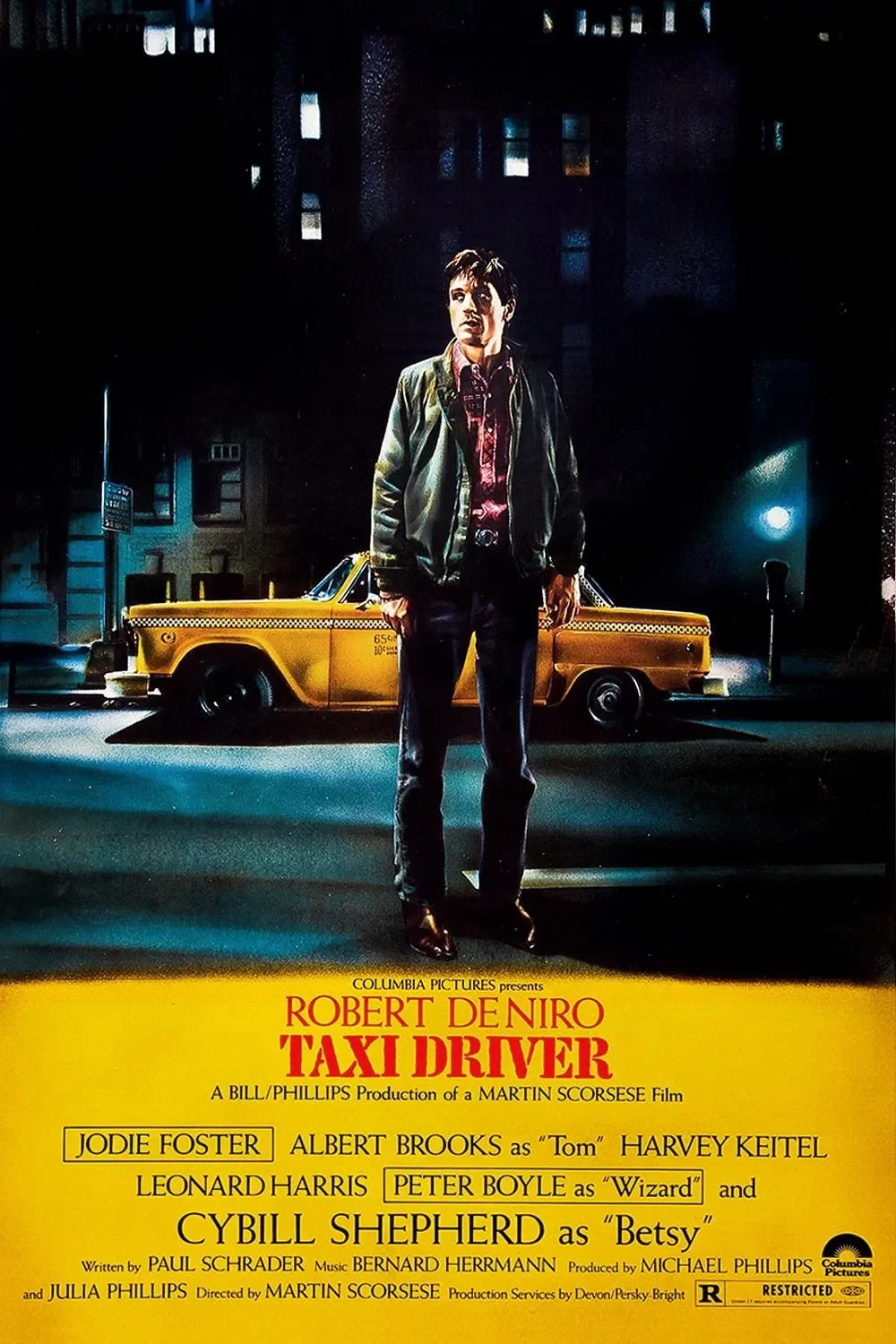
Schrader’s spartan existence while writing the film lends it an incredible voice. Its main character, Travis Bickle (Robert De Niro), has these lurid, disturbing voiceovers throughout the film that narrate his descent into total madness. In the decades since Taxi Driver’s release, Schrader himself has admitted in interviews that he hardly recognizes the film as a work that he wrote. It was a dark time in the young writer’s life, that allowed him to write unsettling Bickle voiceovers such as, “All my life needed was a sense of direction, a sense of someplace to go. I do not believe one should devote his life to morbid self-attention, but should become a person like other people.”
It’s my favorite line in the film. Of course everybody likes to quote the infamous De Niro mirror scene, whether they know it’s from Taxi Driver or not (“You talkin’ to me? You talkin’ to me?), but this earlier voiceover line is a bit more revealing. How disturbing is the idea that Travis Bickle thinks life should be devoted to “becom[ing] a person like other people.” As he drives around the worst sections of New York City in the middle of the night, he literally fantasizes about being a human being. That’s sad and frightening.
It should be noted that as Schrader was writing Taxi Driver in the mid-’70s, there was another poor, young writer out there also writing his first script: Sylvester Stallone with Rocky (which beat Taxi Driver for Best Picture that year). Isn’t that fascinating? Two young, inexperienced writers, toiling away in poverty, simultaneously created a couple of the most iconic protagonists in film history. The two films also signaled a divergence that was soon to happen in popular American culture: Rocky Balboa, the patron saint of always giving it your best no matter the odds, was a harbinger of the approaching ‘80s optimism (as a Reagan ad famously put it, “It’s morning again in America!”). Travis Bickle, with his stubble-headed mohawk and military jacket concealing a .44 magnum, was seen as a symptom of ‘70s malaise, a psychopath forever iconized by the weirdos and punks who hate the system.
But its a testament to Taxi Driver’s greatness that Travis Bickle’s psychopathy doesn’t dominate the film’s legacy in the same way a character like, say, Patrick Bateman dominates American Psycho. Scorsese’s film does much more than just put a killer in front of us to marvel at. It’s a great, great film on its own terms.
Roger Ebert once wrote in the late ‘90s that Scorsese had a knack for making the best American movie for each of the previous three decades: Goodfellas in 1990, Raging Bull in 1980, and Taxi Driver in 1976. I think ol’ Rog has a point.