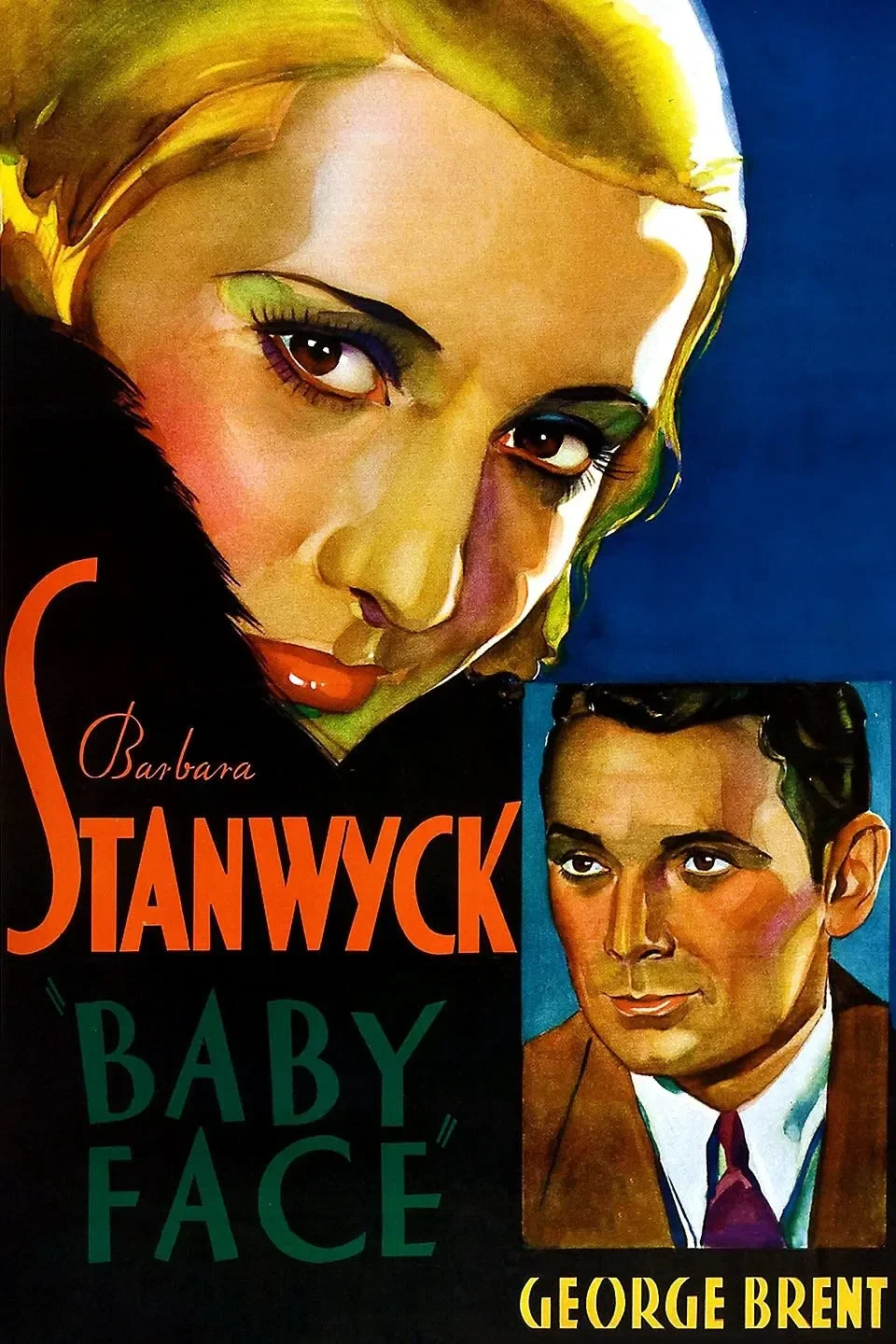
#268: Baby Face
Release Date: July 1st, 1933
Format: 35mm (Los Feliz 3 Theatre in Los Angeles, CA)
Written by: Gene Markey and Kathryn Scola
Directed by: Alfred E. Green
4 Stars
Alfred E. Green’s pre-code film Baby Face, from 1933, sardonically explores gender and exploitation.
Oh, and sex. Lots and lots of sex.
When we first meet the film’s protagonist, Lily Powers (Barbara Stanwyck), she is working as a cheap prostitute in a speakeasy run by her father (Robert Barrat), who is more or less her pimp as well. Lily is resigned to her dirty lot in life, fighting off the unwanted advances of drunks with no money so she can sleep with other drunks who have some to spare. Lily’s favorite patron of the bar, though, is an older German cobbler, Adolf Cragg (Alphonse Ethier), who not only has no prurient interests in Lily, but in fact encourages her to leave this loathsome existence she’s living and strike out on her own.
Lily is skeptical. After all, she’s just a woman, she tells Mr. Cragg. What chance does a woman have out there?
Mr. Cragg bluntly replies, “More chance than men. A woman, young, beautiful like you can get anything she wants in the world because you have power over men. But you must use men, not let them use you. You must be a master, not a slave. Look. Here [Mr. Cragg pointing at the book he’s brought to the bar]. Nietzsche says, ‘All life, no matter how we idealize it, is nothing more, nor less, than exploitation.’ That's what I'm telling you! Exploit yourself. Go to some big city where you will find opportunities. Use men. Be strong! Defiant! Use men to get the things you want!”
The next day, when her father’s distillery explodes, killing him, and with Mr. Cragg’s advice fresh in her mind, Lily decides to skip town for New York City, with her father’s black maid, Chico (Theresa Harris), in tow.
Once there she finds the biggest bank building she can (“Boy, I bet there’s plenty of dough in this little shack”) and confidently walks into their hiring office. There’s a nice guy working the front desk who informs her that the hiring manager is on lunch and won’t be back for an hour.
Lily looks over her shoulder at a crowded waiting room full of other female applicants, then at the hiring manager’s empty office in the far corner. You can see the gears turning in her head. Flirtatiously she leans in towards the front desk clerk and motions towards the empty office, “The boss won’t be back for an hour? Well, then why don’t we go in and talk this over.”
The front desk clerk looks like he’s about to fall out of his chair as he watches Lily seductively stroll past him to the office door, ready to shut it behind her if only he’ll join.
He does, and this sets off Lily’s journey of climbing the corporate ladder in the exact manner in which her mentor taught her: Exploit your appearance. Exploit your sexuality. Use men. Get what you want.
It’s not surprising that Baby Face played a large role in the passage of the Hays Code in 1934, the year after Baby Face’s release. The Hays Code of course was the precursor to our current rating system, its purpose being to reel in the cinematic sex and violence that was becoming increasingly popular in Hollywood productions in the ‘30s. I wonder if industry shotcallers would have been more forgiving of Baby Face if the point of the film was to demonize Lily for her open sexuality? I think they would have been.
But the script from writers Gene Markey and Kathryn Scola does the opposite of demonization. They instead empathize with Lily, and characterize her as a smart young woman who solely targets men in power, the very type of men who would most likely exploit her for sex if she didn’t snare them first.
It’s a great protagonist, and Barbara Stanwyck’s performance is one of my all-time favorites. She’s sexy and funny and wholly believable, and it’s a pleasure watching her, as Lily, tip the scales of corporate power and exploitation. Lily also upends the racial norms of the time by befriending and rewarding Chico, her loyal maid, with the fruits of her labor. In one scene there is a great two-shot of them in Lily’s living room, each wearing extravagant evening gowns and furs, celebrating their success. The former white trash prostitute and a black servant, now living the American Dream, all paid for by sex.
Nietzsche would approve, and then I would like to think that Lily would see if she could get something out of him too.