Release Date: June 21st, 1996
Format: Streaming (Disney+)
Written by: Irene Mecchi, Tab Murphy, Jonathan Roberts, Bob Tzudiker, and Noni White
Directed by: Gary Trousdale and Kirk Wise
3 Stars
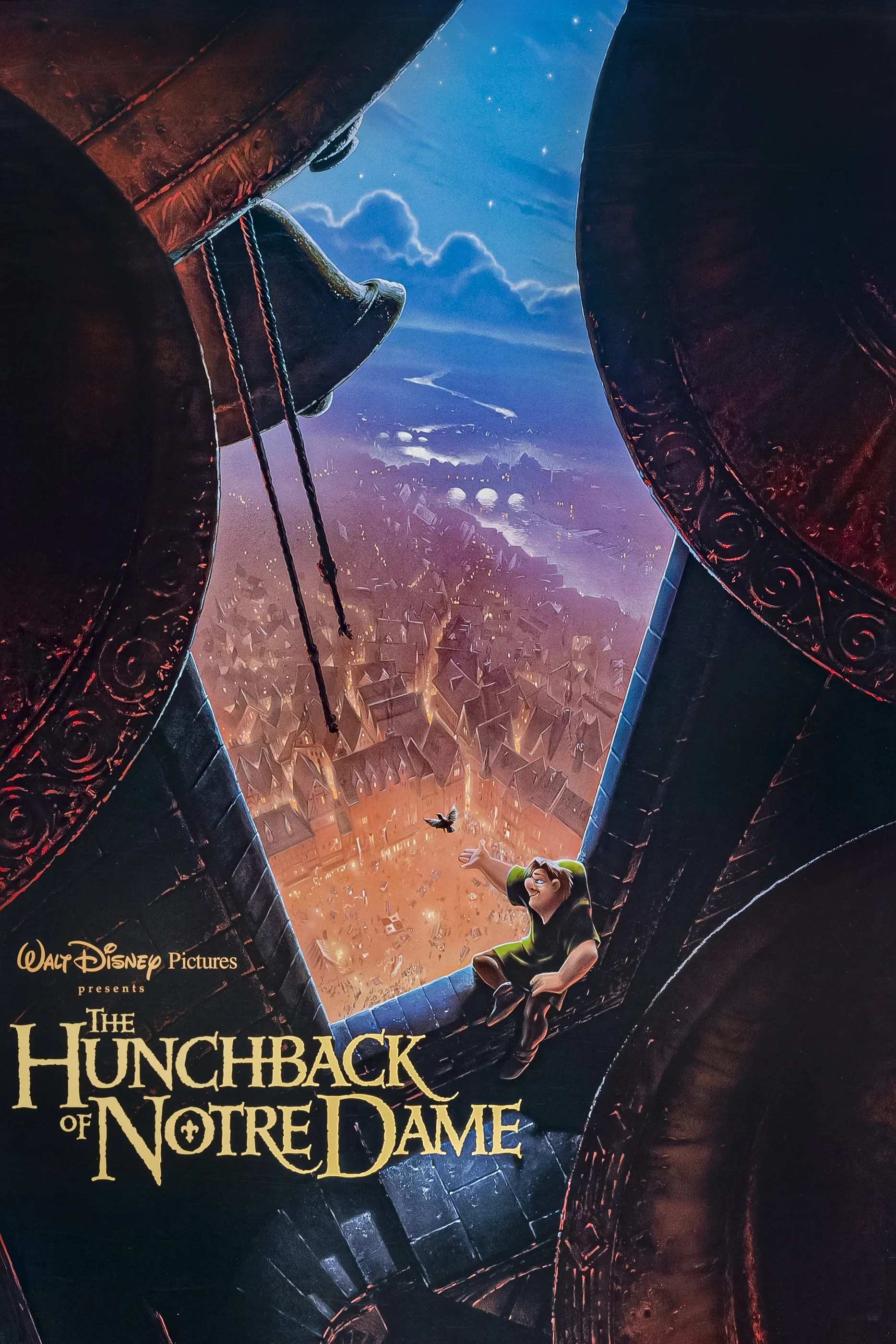
Watching Disney’s attempt to adapt the 19th century French gothic novel The Hunchback of Notre-Dame, you can sense their producers and directors and a whole brigade of creative artists trying to impose the company’s ‘Wish Upon a Star’ pathos - their signature Disney magic - on source material that is inherently darker and more tragic than anything they’ve worked with before.
The story goes that there is a baby, unwanted and deformed, who is raised in the towers of Notre Dame by his rescuer and master, the evil Judge Claude Frollo. Named Quasimodo - translated literally to ‘half-formed’ - the sweet young man spends his life ringing the bells of the cathedral, never venturing down to the streets of Paris. There is also the handsome Captain Phoebus who, in Disney’s telling, is the brave but reluctant right-hand man to evil Frollo. Finally there is the beautiful gypsy girl, Esmeralda, who all three men desire to possess in one way or another: Frollo would like her captured and killed; Capt. Phoebus would like to court and marry her; Quasimodo would like to know her romantically, but in the more literary sense, as a soulmate.
In Victor Hugo’s original novel, all four characters are subjected to horrifying degrees of violence, betrayal, and tragedy: Frollo stabs Capt. Phoebus to death in a fit of jealous rage over Esmeralda, whom he later tries to rape; Esmeralda is framed with Capt. Phoebus’ murder and hanged to death; in an act of vengeance, Quasimodo pushes Frollo off of a bell tower to his death, and then lives the rest of his life alone in the cathedral. The book ends with authorities finding his deformed skeleton embracing the skeleton of another, implying that the recluse dug up the corpse of Esmeralda to have as a companion, even in death.
Not exactly Disney material at first glance.
Fitting a square 19th century gothic peg into a round ‘90s Disney animated-film hole becomes the difficult task for the studio, and in the end they kind of just jam it through. It’s a shame. In the most predictable Disney way the film’s ending has the evil Frollo vanquished, the handsome Capt. Phoebus and beautiful Esmeralda falling in love, and the sweet Quasimodo paraded through the streets of Paris as a hero.
Hardly tragic, it’s exactly the safe ending you’re worried about, which is too bad because the film is largely successful to that point. Alan Menkin’s music is wonderful, the animations are beautiful, and Disney even wades into thematic terrain it’s never explored before, terrain that was bold for a mainstream family film in the mid-’90s. Religion, ethnic discrimination, infanticide, and Quasimodo’s ‘otherness’ are portrayed honestly and appropriately for the movie’s young audience (Dakota loved the film as a child, with its balance of romance and heart-wrenching sacrifice). Watch the scene with Quasimodo hiding behind a pillar as Capt. Phoebus and Esmeralda embrace and you’ll see a distillation of everything great about this film.
If only Disney didn’t cower away from the naturally tragic ending that Hunchback deserves, which is to kill at least one of the story’s three darlings, either Capt Phoebus, Esmeralda, or Quasimodo. You don’t need all three to die necessarily, like in the Hugo’s novel, but one would be enough to marry the film’s tragic themes with its resolution. Too bad that Disney can’t deliver that final fatal blow in what is otherwise a beautiful film.