#197: One Battle After Another
Release Date: September 26th, 2025
Format: DCP (Cinemark at The Pike Outlets in Long Beach, CA)
Written by: P.T. Anderson
Directed by: P.T. Anderson
4 Stars
One Battle After Another is a masterpiece.
Inspired by the Thomas Pynchon novel, Vineland, writer/director P.T. Anderson tells the story of a well-meaning, sensitive, former left-wing underground militant named Pat (alias “Bob”; Leonardo DiCaprio) whose teenage daughter, Charlene (alias “Willa”; Chase Infiniti), is whisked away one evening by his former revolutionary group, The French 75, because she is in danger of being captured by the US military, specifically Colonel Steven J. Lockjaw (Sean Penn), who secretly admired (and lusted after) Willa’s mother, Perfidia Beverly Hills (Teyana Taylor), and has held an obsession with the small family of revolutionaries ever since.
Where has Willa been whisked away to for her safety? That’s a secret that only Bob knows. Well, he should know, if only he had studied the group’s literature and code words more seriously and not pickled his brain with booze and weed for the last fifteen years. Now he can’t remember much.
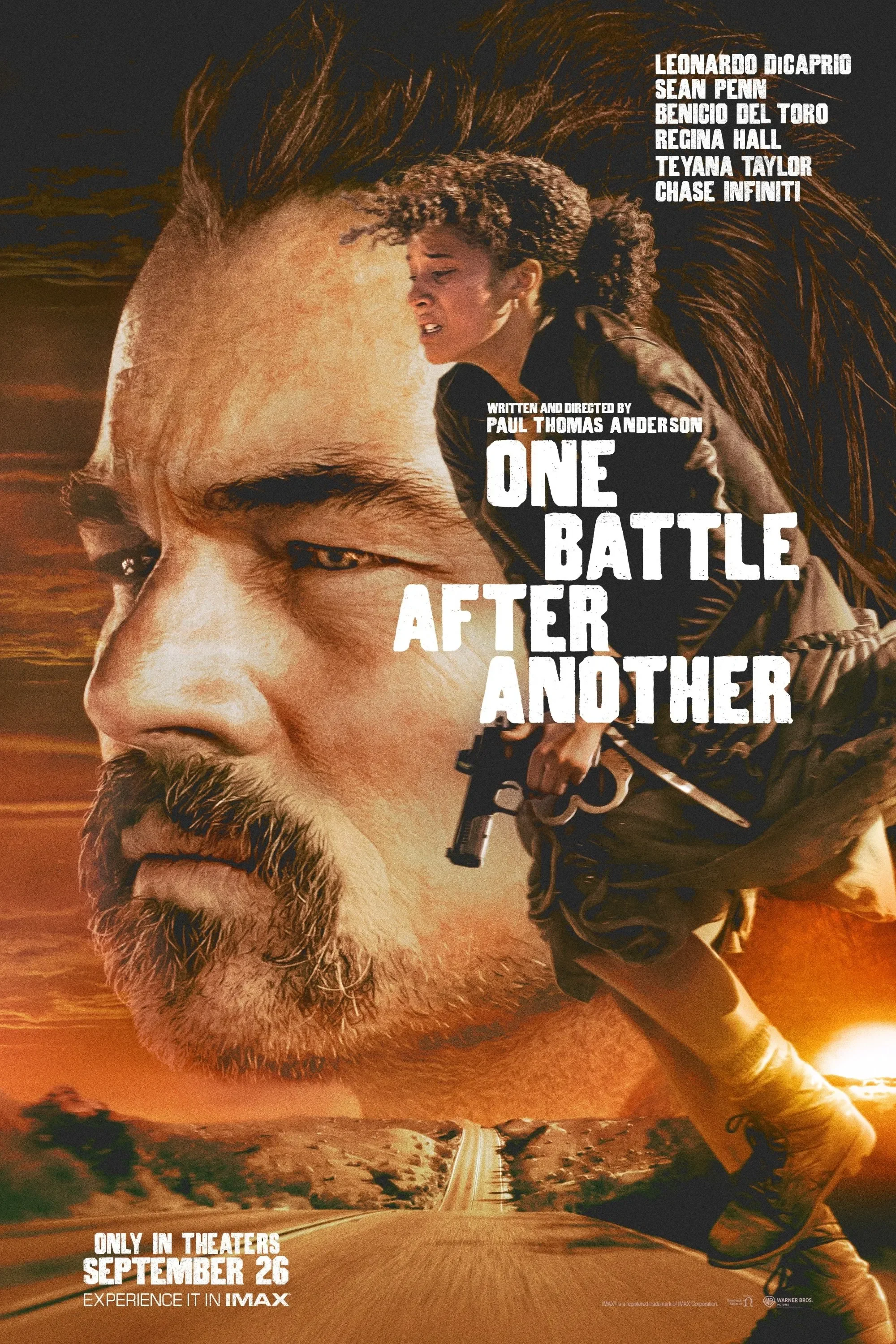
But with the help of his friend and Willa’s karate instructor, Sergio (Benicio Del Toro), and an underground network of mostly young latinos and black women, Bob finds himself on a ramshackle mission to find his daughter before Col. Lockjaw does.
The movie is funny, it’s smart, it’s moving, and it captures something about this post-modern world we live in. If Dr. Strangelove captured the scary absurdity of Cold War-era global politics, One Battle After Another captures America’s current political and racial strife that’s somehow both radical and apathetic.
Just what does revolution look like in 2025? It’s messy and contradictory, and Anderson’s story isn’t embarrassed to admit this. As I watched the film tonight, I kept coming back to the theme of duality that the film presents.
Take for example the film’s central characters:
Bob is a former left-wing radical who has happily settled into a boring domestic life where he can smoke weed all day and watch The Battle of Algiers.
His former lover, Perfidia, is the true revolutionary. But she’s also a snitch, and a bad mother.
Their daughter Willa is smart and beautiful and looks after her loser dad, but her identity is not what she thinks it is. She is not who she thinks she is.
And Col. Lockjaw is a violent fascist, who also loves being humiliated and challenged by women of color and persons of authority.
This theme of duality applies to the politics of the film as well. The police and military are portrayed as thugs and fascists, sure, but also as a tool for the wealthy to keep order and to suppress working class minorities (the scenes with the Christmas Adventurers Club are equal parts terrifying and hilarious). As for his protagonists on the left, Anderson is more sympathetic, but he doesn’t completely absolve them morally. They are passionate, they are well-meaning, but they can also resort to deadly violence and live contradictory personal lives..
I wrote in my review of The Master (#157) that Paul Thomas Anderson loves characters, and specifically he loves finding the humanity in all of his characters. He is not into vengeance or righting wrongs. He loves humans, and whether it’s Bob or Perfidia or Willa, or even a vile man like Col. Lockjaw, he knows that love, no matter how messy, is the binding truth of his cinematic voice.
And his voice as a filmmaker is as strong as ever. Amidst a colorful and rich filmography, One Battle After Another may be Paul Thomas Anderson’s greatest achievement yet.