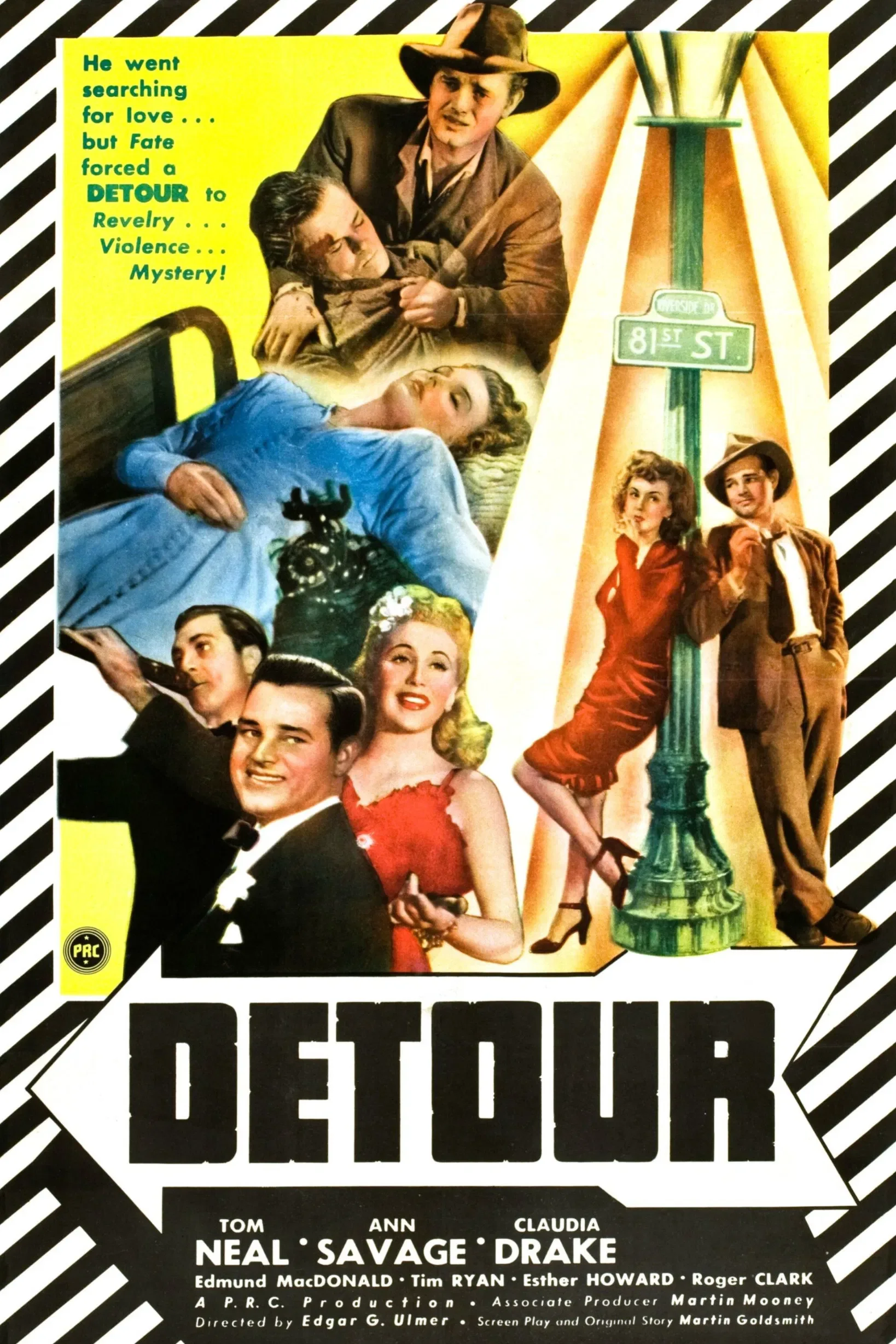
#204: Detour
Release Date: November 30th, 1945
Format: Criterion Collection on Blu-ray
Written by: Martin Goldsmith
Directed by: Edward G. Ulmer
4 Stars
Detour is widely considered the greatest poverty row film ever made. If you’re not familiar with poverty row, these were the smaller, lesser studios of the first half of the 20th century that pumped out hundreds and hundreds of B-movies - lots of horrors, westerns, and in the case of Detour, film noirs - made on shoestring budgets for a quick buck.
They largely featured journeyman directors who could work quickly, modest sets and minimal location shooting to keep costs down, and no-name actors working for scale (or for less; SAG was not established until 1933 and it took four years to negotiate a minimum wage for actors; prior to SAG, poverty row actors were largely exploited, especially women, children, and minorities; I know, shocking).
Watching Detour tonight, it’s easy to see why it’s a diamond in the rough. Yes, it features all of the classic, restrictive traits of a poverty row feature, but overwhelmingly it’s imbued with passion and care. That goes a long way. I’ve only seen a handful of poverty row pictures, but the ones I have seen often feature a static camera and lots of medium shots. Characters are in a room, they talk to each other in a two-shot, maybe the scene ends in a close up, and then the film cuts to the next scene and we get characters in a different room, they talk to each other in a two-shot…you get the idea.
Edward G. Ulmer, in contrast, shoots this thing like his life depended on it. His camera lives. He’ll float it along to follow a character, he’ll subtly push in to emphasize something important, he’ll go in and out of focus, and he’ll pull wide to establish the space of a scene. He expertly frames Detour, despite just a 14-day shooting schedule (he always claimed six days; to be fair, I’m sure it felt like only six days). I did notice some small continuity issues, but these were easily outweighed by his overall mise en scene and the sheer effort he puts into his visual storytelling.
As for the story, it’s told through voiceover narration by our main character, a pianist named Al (a perfectly cast Tom Neal, wearily handsome, with a hint of menace) who works at a smoky nightclub in New York City, where he falls in love with the club’s singer, Sue (Claudia Drake). Sue has aspirations to make it big in show biz and moves to Hollywood, much to Al’s displeasure. Unwilling to give up on the romance, he decides he’s going to hitchhike across the country to marry her. He makes it all the way to Arizona when he’s picked up by a shady character named Charles Haskell (Edmund MacDonald).
The rest of the movie involves a great femme fatale (how much fun is lead actress Ann Savage having?), two suspicious accidental deaths, some subterfuge, and a whole lot of heartbreak.
I like the decision to have Al narrate. A suspicious death is one thing, but two suspicious deaths? I get the feeling ol’ Al might not be telling the whole truth.
It’s a tremendous little film noir that punches well above its weight class.
Postscript: It was fun watching Detour after watching City Lights (#203). Both are classics within their genres, but they are opposites in many ways. Detour had a relatively small budget, which allowed for just a few sets and even fewer locations to shoot on, whereas City Lights had a seemingly endless budget, with Chaplin’s deep pockets allowing for the construction of an entire city block and hundreds of extras at his disposal; Detour was shot in 14 days, whereas City Lights was shot over the course of two years, in which Chaplin would tinker and experiment while shooting (City Lights used over 300,000 feet of film, of which only 8,000 was used in the final cut); Edward G. Ulmer made Detour as best he could, but probably with the modest ambition that it was good enough to secure him future work, whereas Chaplin risked his entire reputation and financial empire on City Lights, a huge silent movie production started when all the American public wanted to see were talkies.