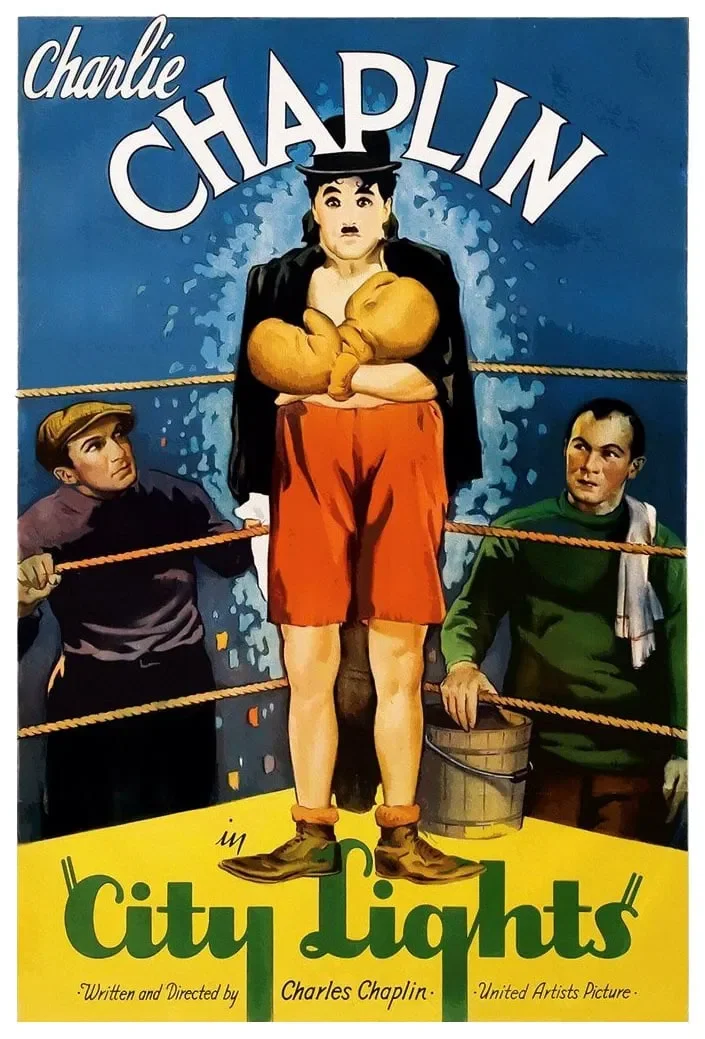
#203: City Lights
Release Date: March 7th, 1931
Format: Criterion Collection on Blu-ray
Written by: Charlie Chaplin
Directed by: Charlie Chaplin
4 Stars
What can I say about City Lights?
It’s the greatest film by my favorite filmmaker, Charlie Chaplin.
It’s the closest he ever got to his idea of storytelling perfection: Comedy and pathos - which are inextricable in his worldview - conveyed through universally understood themes and imagery.
The story is about his Little Tramp character, who meets a blind girl (Virginia Cherrell) selling flowers on the sidewalk. Shunned by society, the Little Tramp finds solace in the company of the blind flower girl: she cannot see him, hence she cannot judge him for his ragged clothing and small stature. What he does not know is that she largely feels the same way he does, that is, she is thankful that she has also found someone who accepts her for who she is.
One day the Little Tramp befriends a wealthy drunk (Harry Myers) whose wife has just left him, and the two bond over a night of drinking. This relationship humorously ebbs and flows - as relationships with drunks often do - and eventually leads to the drunk gifting the Little Tramp $1,000 to help the blind flowergirl pay her past due rent (a subtle critique from Chaplin that the wealthy don’t have a clue about the working class lifestyle; not only is the $1,000 easy for him to give, but he thinks that is what is owed for rent in 1930; in fact, the flower girl’s past due rent is just $22).
But wouldn’t you know it? This $1,000 can also help the flower girl travel to Vienna, where a doctor has just discovered an experimental surgery that can restore sight in the blind.
The only downside, the Little Tramp fears, is that he’ll lose his beloved flower girl forever. Once her sight is restored, surely she’ll see that she is beautiful, and he is not.
The final scene, and not to sound hyperbolic, but possibly the greatest scene in the history of cinema, has the Little Tramp, down on his luck, shuffling along the sidewalk and happening upon the very spot where he and his flower girl first met. It’s been months since he’s seen her, but then, just down the street, he sees her once again, this time behind a large glass window of a successful flower shop that she now owns.
And she sees him.
Behind the window, she politely jokes with one of her employees about the little hobo staring at her. Through the glass she offers him a flower, but he is hesitant. Generously, she then holds up a half-dollar she hopes to give to him as well, but he is scared and quickly tries to walk away. She hurries to the front door and calls to him. He pauses, then timidly approaches her.
He accepts the flower, but won’t take the charity. She insists once again, and grabs his hand.
He surely has a lump in his throat, and so do we.
She pauses, holding his hand. She looks at him deeply, and recognizes him.
Then she smiles, and so does he. And that’s the end of the film.
In this moment, Chaplin is able to convey love and fear and joy and sadness.
It’s a moment that fully encapsulates him as an artist.
It’s a monument.