#227: Five Easy Pieces
Release Date: September 12th, 1970
Format: DCP (Los Feliz 3 Theatre in Los Angeles, CA)
Written by: Carole Eastman (credited as Adrien Joyce)
Directed by: Bob Rafelson
4 Stars
Bob Rafelson’s seminal 1970 film, Five Easy Pieces, is about a California oilfield worker named Bobby Dupea (Jack Nicholson). Bobby spends his days getting drunk before work with his peabrained co-worker, Elton (Billy “Green” Bush), then his evenings devolve into more drinking and bowling. He regularly cheats on his sweet-but-simple, country music-loving girlfriend, Rayette (Karen Black), and is generally just a miserable bastard.
He’s also not exactly who Rayette and his friends think he is. When he gets word from his sister (Lois Smith, still alive at 95-years-old, bless her soul) that his father (William Challee) is sick, we learn that Bobby is actually a classically trained pianist from an upper-class family that lives on a picturesque island in Washington State’s Puget Sound (unnamed, but I’m going to guess Whidbey).
With Rayette in tow, Bobby makes the painful decision to return home to visit his father, and it doesn’t take long for us to realize that he really is a man with no country. While he disgruntingly suffers the simpletons he lives amongst in rural California, he equally despises the wealth and social expectations of his family in the Pacific Northwest, especially those of his dying father.
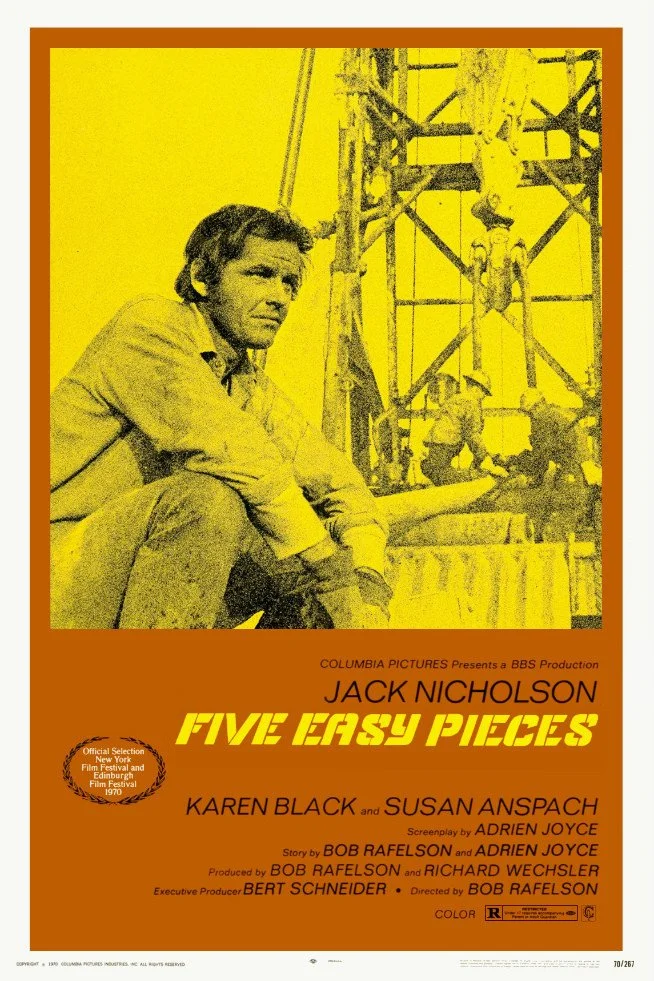
Carole Eastman’s tremendous script doesn’t provide Bobby (or us) much solace as the film moves along. Released 15 months after Midnight Cowboy, the two films were a harbinger of the malaise of the 1970s: the cultural revolution of the ‘60s was a bust, where the old money made out okay, but the youth were left with labor, meaningless sex, and addiction.
I love this movie. The title is a reference to the five classical pieces of music that are featured in the film, one of which Bobby plays for his brother’s fiancee, Catherine (Susan Anspach), an aspiring pianist herself. She is brought to tears by the performance, then Bobby tells her that he only played it because it was the easiest song he could think of, something that he probably played better when he was ten-years-old. She tells him that the simplicity of the piece didn’t matter, it was the emotion with which he played it that moved her.
Bobby earnestly tells her that he felt nothing. The song means nothing to him.
Herein lies the heart of the film: it’s about a man who says he feels nothing. Whether it’s a doting girlfriend, a good education, a sister who adores him, a safety net of wealth that affords him as reckless a life as he can imagine…it’s all shit according to Bobby Dupea. He even tells them as much in the living room of the family home, “You’re all full of shit,” he says, before storming out.
It’s not until Bobby finally speaks with his father, alone, that we learn Bobby is the one full of shit. He feels things deeply. He confesses his shame. He admits his aimlessness. In his words, he moves to a place until things turn bad and then he runs away to a new place. His father looks at him stoically - a stroke has rendered him mute and partially paralyzed.
Whatever answers Bobby is seeking will have to come from himself.
The film’s iconic ending implies that he’s nowhere close to finding those answers, if he can ever find them at all.