#343: Apocalypse Now (1979 cut)
Release Date: August 17th, 1979
Format: DVD
Written by: Francis Ford Coppola and John Milius
Directed by: Francis Ford Coppola
4 Stars
Since my co-workers have been yapping about The Odyssey for the last couple of weeks, I decided why not dust off my DVD copy of another Hollywood epic, 1979’s Apocalypse Now, and see how the two measure up.
First I’ll say that they’d make for a tremendous double-feature, if you had six-and-a-half hours to kill.
Now, I began my review of The Odyssey by saying that Christopher Nolan “has never been my guy,” even though I admire the scope of his films. He’s a bit dour for me, and his preoccupations - namely sacrificial male heroes who suffer valiantly - are glum, too. Yes, I loved the experience of watching The Odyssey, with its enormous production values and its total sensory assault on the viewer, but the film still represents an extension of Nolan the Auteur, not necessarily growth from Nolan the Auteur.
I can’t think of a better contrast to Nolan and his Odyssey than Coppola and his Apocalypse. If the former filmmaker is calculating, repressed, serious, intellectual, withholding, and hero worshipping, the latter is expressionistic, passionate, experimental, colorful, wasteful, and risk-taking.
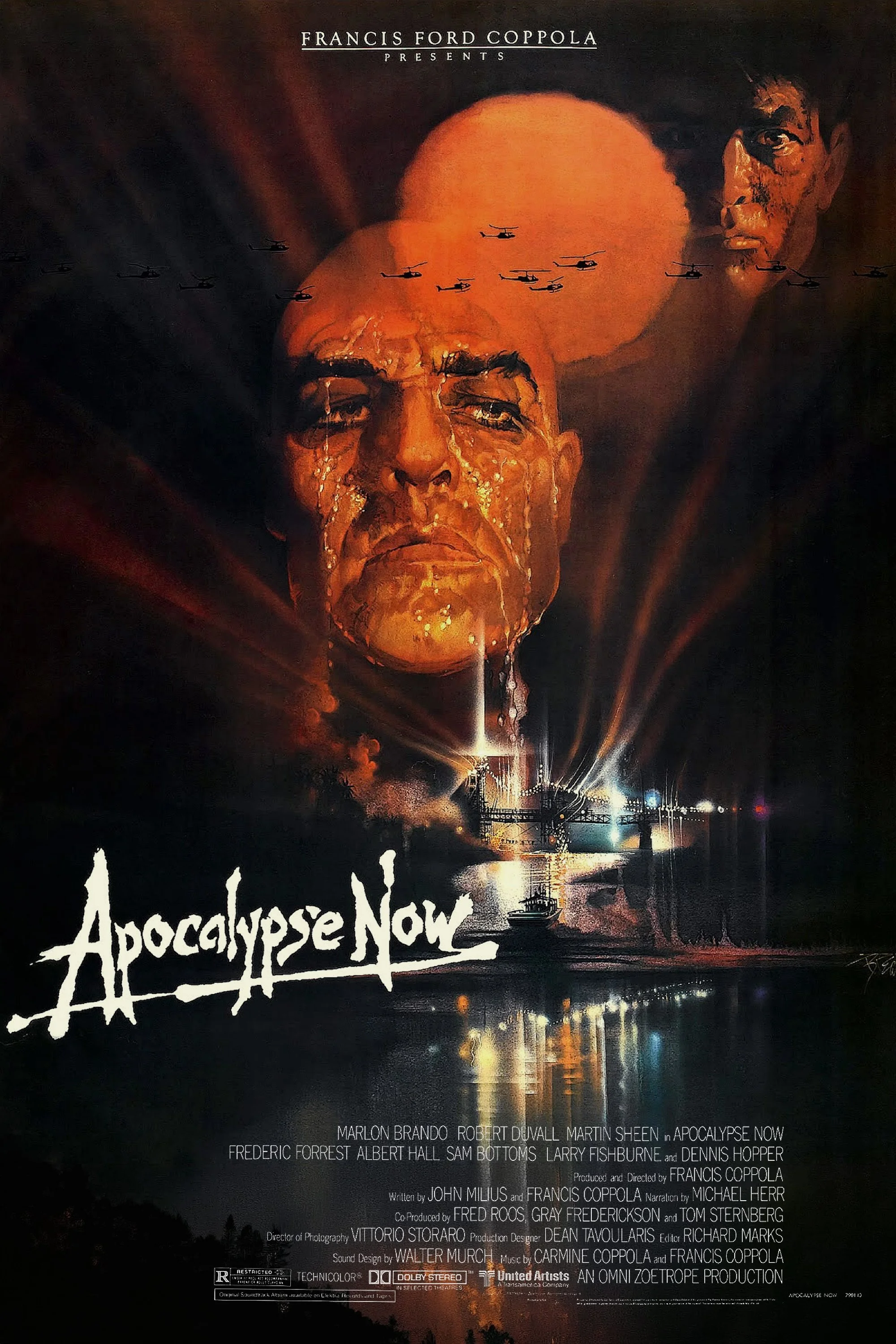
Apocalypse Now’s story, a loose adaptation of Conrad’s Heart of Darkness, concerns Army Captain Benjamin L. Willard (Martin Sheen) accepting a top secret mission to travel through North Vietnam into Cambodia to eliminate “with extreme prejudice” the highly decorated, AWOL, and increasingly revolutionary Colonel Walter E. Kurtz (Marlon Brando).
The film famously opens up with a shot of a jungle tree line and the slow-mo sounds of helicopter blades. Coppola slowly fades in The Doors’ song, “The End,” when suddenly the trees are hit with bombs and engulfed in orange flame. The song grows louder. As we watch the conflagration, Jim Morrison sings:
This is the end, beautiful friend / This is the end, my only friend, the end
Of our elaborate plans, the end / Of everything that stands, the end
No safety or surprise, the end '/ I'll never look into your eyes, again
Can you picture what will be? / So limitless and free
Desperately in need
Of some stranger's hand / in a desperate land
Lost in a Roman wilderness of pain / and all the children are insane
All the children are insane / waiting for the summer rain, yeah…
On the DVD’s commentary track, Coppola enthusiastically shares how this opening scene came about: His editor, Walter Murch, was leaving the production because Coppola was so grossly over schedule, and Coppola wanted to sit with him on his final day to see where the film’s rough cut currently stood. While in the editing room Coppola noticed a drum of rolled up film on the floor (there were probably many drums; Coppola shot one million feet of film for the picture).
“What is that?” Coppola asked.
“Filler,” Murch replied.
Curious, Coppola asked for the cutaway footage to be projected. It was beautiful, he found, with helicopters cutting across the frame and the wind blowing through the trees. The explosions were spectacular.
“What if we use this for the opening?” Coppola asked.
“Sure,” Murch muttered, one foot out the door.
It was later that Coppola decided to play “The End” on the opening scene’s soundtrack, sort of as a goof, but also as a commentary on the meaninglessness and contradictory nature of Capt. Willard’s mission to kill Col. Kurtz, and of the Vietnam War in general. Labeling either Willard’s mission or the larger war with arbitrary time markers like ‘beginning’ or ‘end’ is futile. The madness in the jungle renders time obsolete.
The process of Coppola finding this film strip on the floor, then finding his film in the editing room, then finally finding his authorial voice through experimentation is what separates him from Christopher Nolan. It explains why Coppola reached higher creative peaks than Nolan seemingly ever will, but it also explains why Nolan is a consistently more reliable and bankable Hollywood filmmaker.
Watch The Odyssey and you’ll see an exacting, intelligent, and efficient filmmaker navigating a $250 million budget; as big as Nolan’s production is, you get the sense that this has been planned and storyboarded and coordinated for years.
Watch Apocalypse Now and you’ll see a risk-taking, experimental, and inefficient filmmaker losing total control of his $31.5 million budget (about $130 million today); when you hear the behind-the-scenes anecdotes of Coppola leveraging his rights to The Godfather to secure extra money, or mortgaging his house to pay for more film, or telling his wife through tears that he realistically thinks he only has a 20% chance of finishing the film at all, you totally believe it.
In Coppola’s words, he created his own Vietnam while making his film about Vietnam. It consumed him, and almost destroyed him.
Thankfully it didn’t, but it was the last great movie that he ever made. Maybe his best.
The film works on so many interesting levels. It explores the contradictions of war, of course. Coppola (and co-writer John Milius) give us devastating scenes of violence perpetrated by men who are often too desensitized to understand it.
We also witness acts of humor, vulnerability, and love. This is contrasted with depictions of racism, drug addiction, and exploitation. Apocalypse Now makes us a witness to the total moral nihilism that occurs when one race of man determines that another race of man should no longer exist.
It’s a miracle that Coppola pulled it off. He was millions over budget, years over schedule, and shooting in a jungle that constantly wrecked his sets with typhoons and bugs and moisture. Even the ace up his sleeve, the casting of his friend Marlon Brando as the powerful Col. Kurtz backfired; Brando showed up to set months late and nearly 100lbs over weight.
But Coppola figured it out. He shot Brando in shadows, draped in loose linen clothes. He had him shave his head like a monk. Like any true artist, Coppola saw the limitations imposed on him as an opportunity to explore and experiment with alternatives. Instead of a limitation on the film, Brando’s Col. Kurtz is an almost mystical presence. He has Coppola to thank for this.
Casting his leading man was problematic, too. Coppola reached out to a who’s who of 1970s stars for the role of Capt. Willard: McQueen, Pacino, Nicholson, Redford, De Niro, Caan, even Eastwood. None of them wanted to spend weeks shooting in the jungle. Coppola then attempted to reimagine the lead character to better suit Harvey Keitel, who accepted the role, only to be subsequently fired by Coppola during filming. Keitel was simply too engaging, too lively. Coppola saw Capt. Willard as more of an observer, as a man being thrust into the heart of darkness as a witness, not as a participant. After Keitel’s dismissal, all those scenes had to be expensively re-shot with the new lead, Martin Sheen, a much less famous performer than the A-listers Coppola was hoping for, but a committed and talented performer nonetheless (I like Sheen in the lead, but one can’t help but wonder what one of those other actors would have made of the role). In fact, Sheen was so committed to the role that he ended up suffering a heart attack during production, brought on by three packs of cigarettes a day and sweltering heat, amongst all the other demanding shooting conditions.
What did Coppola do while his lead actor was on bedrest for weeks? Again, like any good artist, he improvised. He kept shooting what he could, and then hired Sheen’s brother, Joe Estevez, to act as a stand-in until Sheen was recovered.
By all accounts Apocalypse was a nightmare of a shoot, so bad in fact that it served as the subject of Hearts of Darkness, a behind-the-scenes documentary shot by Coppola’s wife, Eleanor.
But it’s these nightmarish conditions, a critical weakness during filming, that ultimately serve as the film’s greatest strength. Lost in a land far from home, out of money, and forced to make artistic decisions out of pure necessity, Coppola pulled off one of cinema’s greatest long shots of all time.
Postscript: So, is it better than The Odyssey? I think so, even if the comparison isn’t exactly fair. Considering the notoriety surrounding Apocalypse’s production, I’ll definitely say that it feels more special than Nolan’s film.