#74: Megalopolis
Release Date: September 27th, 2024
Format: DCP (Cinemark at The Pike Outlets in Long Beach, CA)
Written by: Francis Ford Coppola
Directed by: Francis Ford Coppola
2 Stars
I found myself sort of rushing home to write this review, and not in a good way, unfortunately. I wanted to quickly capture my primary thoughts and feelings on this important movie before any sort of mental gymnastics could take place in my mind, where I began justifying and making amends with Francis Ford Coppola’s visionary tale.
I’m home now, so here it goes: Megalopolis doesn’t work. There, I said it. It doesn’t work. And it especially doesn’t work as a narrative.
Walking home from the theater with Baruch, he offered that maybe Coppola’s film is a futuristic allegory of Christ, had he not been crucified. That sounds interesting, but the problem with Coppola’s script is that there is a shocking lack of narrative tension. I felt almost nothing as I watched the movie. My mind was activated, but my heart was still. There are some incredible visuals, but they mostly washed over me as I tried to find a heartbeat in these characters.
And when I say characters I’m being generous. These are archetypes: The genius savior (Adam Driver) and his star-crossed lover (Nathalie Emmanuel); the powerful patriarch (Jon Voight); the sensible, if short-sighted politician (Giancarlo Esposito); the Judas (Shia LaBeouf); the Lady Macbeth (Aubrey Plaza). At 138 minutes, you’d think I’d feel something towards these people bound in a struggle for power over human civilization. Nope.
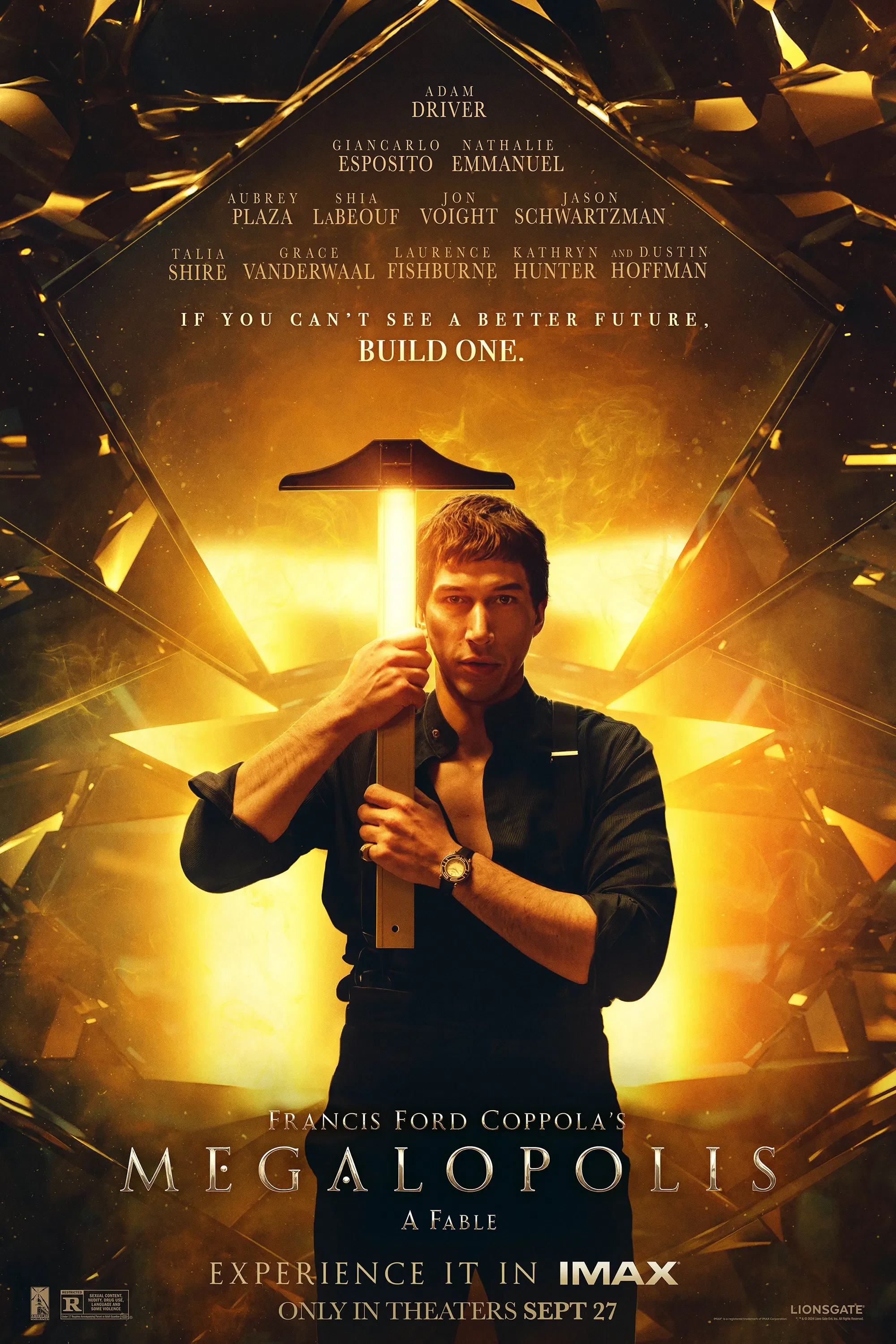
So if Megalopolis doesn’t work as a narrative, maybe it works as an intellectual exercise? Granted, I may have missed something here, but the theme of the film seems practical rather than ambitious. The visual granduer seems to imply a much bigger idea than is actually there. What I gathered from the film is that we, human beings, should honor each other and the animals we protect, and look out for our children.
How did I come away with this? Well, Coppola writes it in big letters across the screen as the movie ends. And Lawrence Fishburne reads it out loud for the audience, just in case you’ve been resting your eyes the past two hours.
There are a few slightly embarrassing moments in the film, but this one might be the worst culprit.
So what’s the Coppola legacy, now that he’s in his mid-80s and he just blew $136 million of his own money on a visionary fable that is underwhelming at best? He’s clearly a filmmaker that does his best work under the gun. The Godfather (#228), The Godfather Pt. II, The Conversation (#138), and Apocalypse Now were all made under some sort of personal, professional, or financial duress (they also happen to have been made during the same 10-year span when Coppola was a much, much younger man).
Another important aspect of Coppola’s legacy, beyond making a few of the greatest films ever made, should be his shepherding of his “Movie Brats” colleagues into the filmmaking industry. In one way or another, the slightly older Coppola wore a path for his fellow film and TV nerds who would comprise the “New Hollywood” of the 1970s: Scorsese, the enthusiastic New York City cinephile; Spielberg, the wunderkind hitmaker; Lucas, the world-building super nerd; De Palma, the stylistic shockmaster.
But just before any of them broke through, there was Coppola, the risk-taking artist, who later put his financial and professional career on the line time and time again.
Megalopolis affirms his identity as an artist, even if it’s a bad movie. At the end of the day the old man put his own money on the line for a big budget flop, which is a disappointing, but it shows Coppola is still willing to experiment and create after sixty years in the industry. That’s downright admirable.
But like many great artists, Coppola works better under constraints, not without them. Megalopolis is Exhibit A.