#276: Mom
Release Date: June 12th, 1991
Format: Streaming (Tubi)
Written by: Patrick Rand and Kevin Watson
Directed by: Patrick Rand
4 Stars
So there I was on a Wednesday night, searching Tubi for the notorious 1945 exploitation film, Mom and Dad. No luck.
But one of the little preview tiles that popped up was for something simply called “Mom.” The image on the tile depicted a little old white lady knitting, and behind her was some sort of monster with fangs. The title font was blood red and looked like claw marks.
Okay, I’m in.
Talk about a lucky detour. Mom is, I think, a masterpiece. This might be my first hot take in the two-and-a-half years I’ve been writing movie reviews, but I’m not trying to be provocative. I genuinely think that this horror/comedy from one-and-done writer/director Patrick Rand is a great movie.
The internet would tell you otherwise. Mom doesn’t have a Wikipedia entry; IMdB has a user rating sitting at 5.4 out of 10; Letterboxd has it at 2.9 out of 5; at Rotten Tomatoes, 34%. It appears it went straight-to-video, but every website I checked listed various release dates ranging from January 1st, 1990 to July 19th, 1991. I could find no contemporaneous critic reviews.
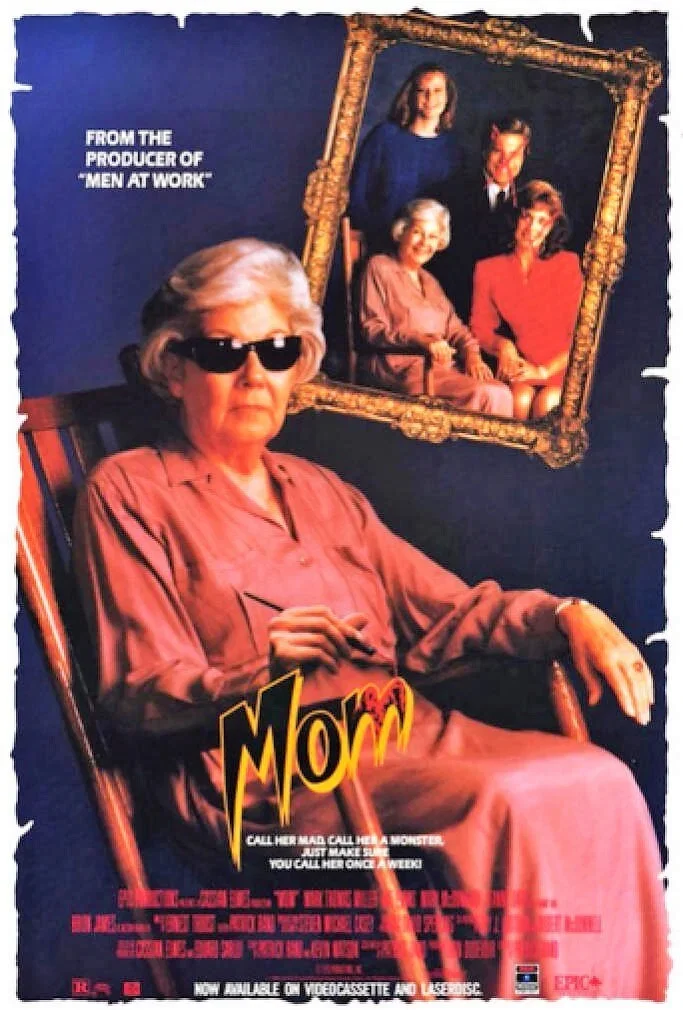
But I’m telling you, this is a great movie.
The story involves a Los Angeles newscaster named Clay (Mark Thomas Miller), who visits his sweet, elderly mother, Emily (Jeanne Bates), on Christmas eve with his girlfriend, Alice (Mary Elizabeth McDonough). Clay is a good man, and a good son. While unwrapping gifts, Clay and Alice let Emily know that they are expecting a child. Emily is overjoyed to become a grandmother.
This idyllic holiday setting is interrupted the next day when Emily receives a knock at her front door from a mysterious man named Nestor (Brion James), inquiring if she has a room to rent. She in fact does, and kindly welcomes Nestor into her home. Unfortunately for Emily, Nestor is not a man, but something else entirely, something sinister (in his own words, “Vampire, werewolf, ghoul…it’s all the same”). That evening Nestor corners Emily in the dining room, transforms into his true self, and viciously attacks her.
When Clay and Alice don’t hear from Emily for several days, they pay a visit to her house and find Nestor in the living room. He tells them that Emily has been sick, and is in bed. Clay goes upstairs and finds his mother alive, but…different. He suspects that something is terribly wrong, and that Nestor might be the culprit.
One evening days later, Clay returns to the house to check on his mother. When he arrives, he sees her leaving in a taxi cab with Nestor. Clay follows them downtown in his car and, to his surprise and disgust, sees his mother and Nestor attack and kill a transient man. When Clay approaches down a dark alley to get a closer look, he sees his mother eating a human being.
Clay confronts them both, gets his mother away from Nestor and into his car, and they both retreat to her house so Clay can get his thoughts straight and plan on what to do next.
Nestor follows, and when Clay goes to the kitchen to call the police, Nestor attacks. A struggle ensues, and Clay manages to light Nestor on fire with the gas range, killing him.
Clay is left momentarily stunned and confused, but soon he comes to the realization of what is going on: Nestor has transformed his own mother into some sort of monster. A monster that eats only human flesh.
One of the things that I love about Rand’s script is that all of this happens in the first thirty minutes of the film. Most horror B movies would stretch this out over their 90-minute run time, but Rand puts it all in his first act.
So what does he do with his second and third acts? The movie kind of transitions into this touching allegory about adult children caring for aging parents. In the movie, Clay sequesters his mother to her room, where she knits most of the day and stares longingly out of the window. She’s a danger to herself and others if she leaves the house.
But she’s hungry all of the time. Should Clay…feed her? What happens if he doesn’t? The stress and worry about how to care for his mother starts to affect his work and his relationship with Alice. He also worries about his unborn child. His mother wouldn’t dare hurt her own grandchild, would she?
I’d love to speak with Rand about his script, and ask him just how allegorical he meant it to be (there is an out-of-print Blu-ray copy of Mom on eBay for $45 that features an audio commentary with Rand; I might just have to bite the bullet). If he says on the commentary that he at one point had a parent struggling with Alzheimer’s or dementia, it wouldn’t surprise me one bit.
Allegory or not, though, Rand never gets overly sentimental. There are some great thrills here, and some genuine scares. It’s also funny at times, both intentionally and unintentionally, which I enjoy in a low-budget monster flick.
Rand also has a genuine eye for lighting and composition. It’s a great looking movie, with some film noir touches mixed with that ‘80s slasher aesthetic. In the opening scene, where Nestor attacks a young female hitchhiker , take a look at Rand’s expressionistic staging. It’s immediately apparent that this isn’t some lazy, schlocky genre cash-in.
This is an auteur. He’s made a genre-bending allegory that’s got scares, ideas, and a big heart. It’s frustrating that this was his only time behind the camera. Makes me want to go out tonight and bite somebody’s neck wide open.
Postscript: In reading about Mom after I wrote my review, I came across The Schlock Pit, a great website (theschlockpit.com) which had some helpful information about the film. Turns out it was a straight-to-video release with a shooting budget of $500,000. If you want to know more about Mom and some of the talent involved in its creation, check ‘em out.