#277: Pickpocket
Release Date: December 16th, 1959
Format: 35mm (Los Feliz 3 Theatre in Los Angeles, CA)
Written by: Robert Bresson
Directed by: Robert Bresson
4 Stars
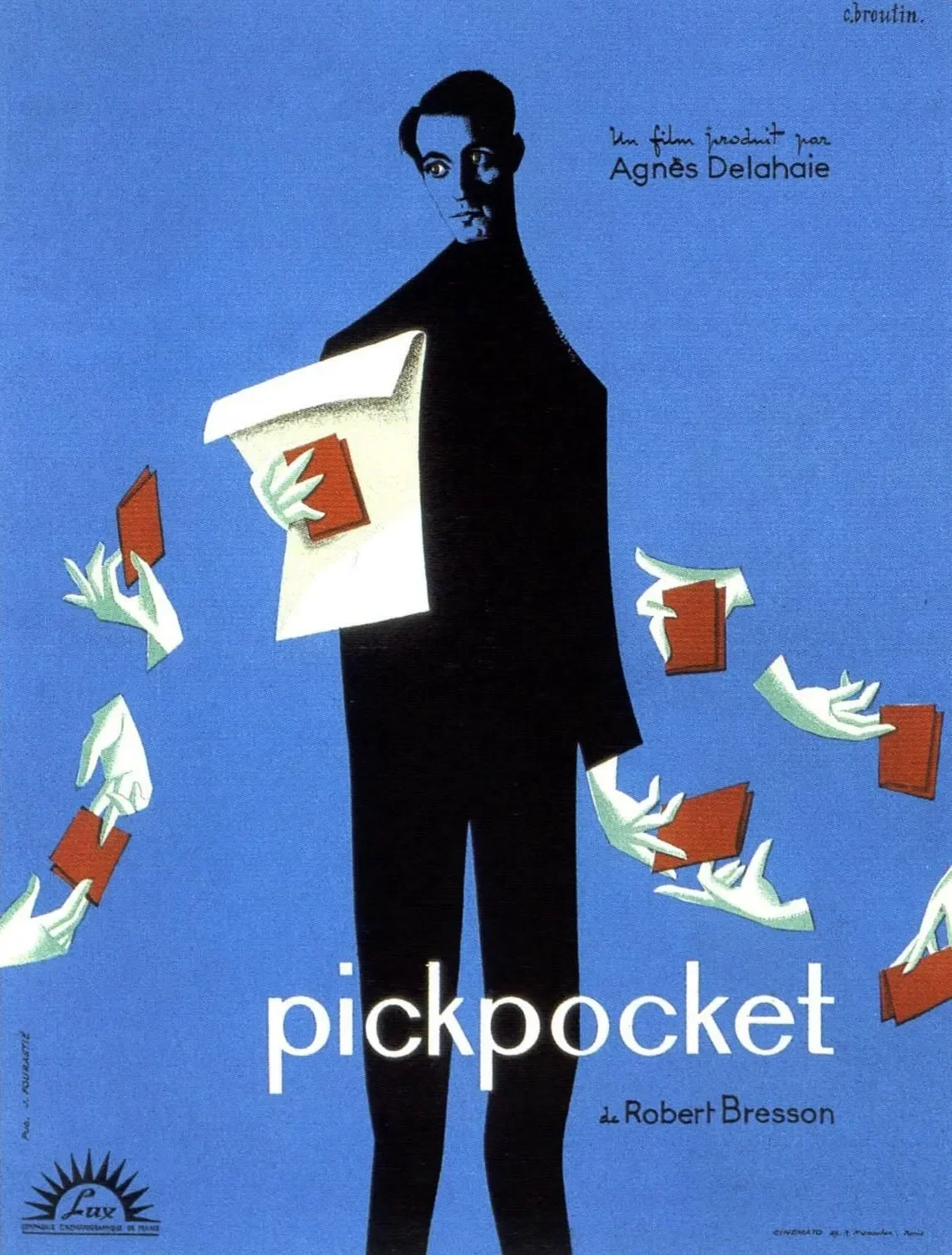
What better way to beat a gross winter heatwave in Los Angeles than to drive to the Loz Feliz 3 Theatre and steal some air conditioning? Even better, what if the film showing was Robert Bresson’s classic crime drama, Pickpocket, a sober examination of poverty, narcissism, and disloyalty?
Sounds pretty chilly to me.
I’m by no means an expert on the French master - this is in fact the first Bresson film that I’ve seen - but I greatly enjoyed it. I saw some influence from Italian Neorealism, and a whole lot of influence from classic Russian literature, Dostoyevsky especially.
The story is about a pickpocket named Michel (Martin LaSalle), who lives a largely solitary and inward existence. He’s not an especially skillful thief; you get the sense that he chose the job rather than the job choosing him. He even has two friends, Jacques (Pierre Leymarie) and Jeanne (Marika Green), who encourage him to accept a stable job.
Michel avoids their entreaties. He also avoids contact with his ill, elderly mother (Dolly Scal).
We’re not sure why Michel is such an isolationist at first. He plays things close to the vest, that is, until a rendezvous at a local bar with Jacques and, coincidentally, the off-duty police chief (Jean Pélégri) who had just released Michel from jail days earlier. In casual conversation, Michel starts to reveal some of his core beliefs.
Are there objective morals in a society? Michel doesn’t think so. Furthermore, should society’s rules apply to everybody? What about those special individuals with exceeding intelligence and righteous beliefs? Shouldn’t they be able to skirt the law from time to time, if the ends justify the means?
The police chief tells him that’s a dangerous proposition for any man, even the righteous.
Michel is visibly indignant.
It’s not until the film’s final act, when the walls start closing in around Michel, that we learn just how flawed a man he is, and why he’s been avoidant of his own mother.
It turns out that Michel’s core beliefs in moral exceptionalism weren’t true beliefs at all, but rather cowardice and self-denial.
In the end, we see a man who must be reduced to nothing in order to truly see who he is.